27/08/2026
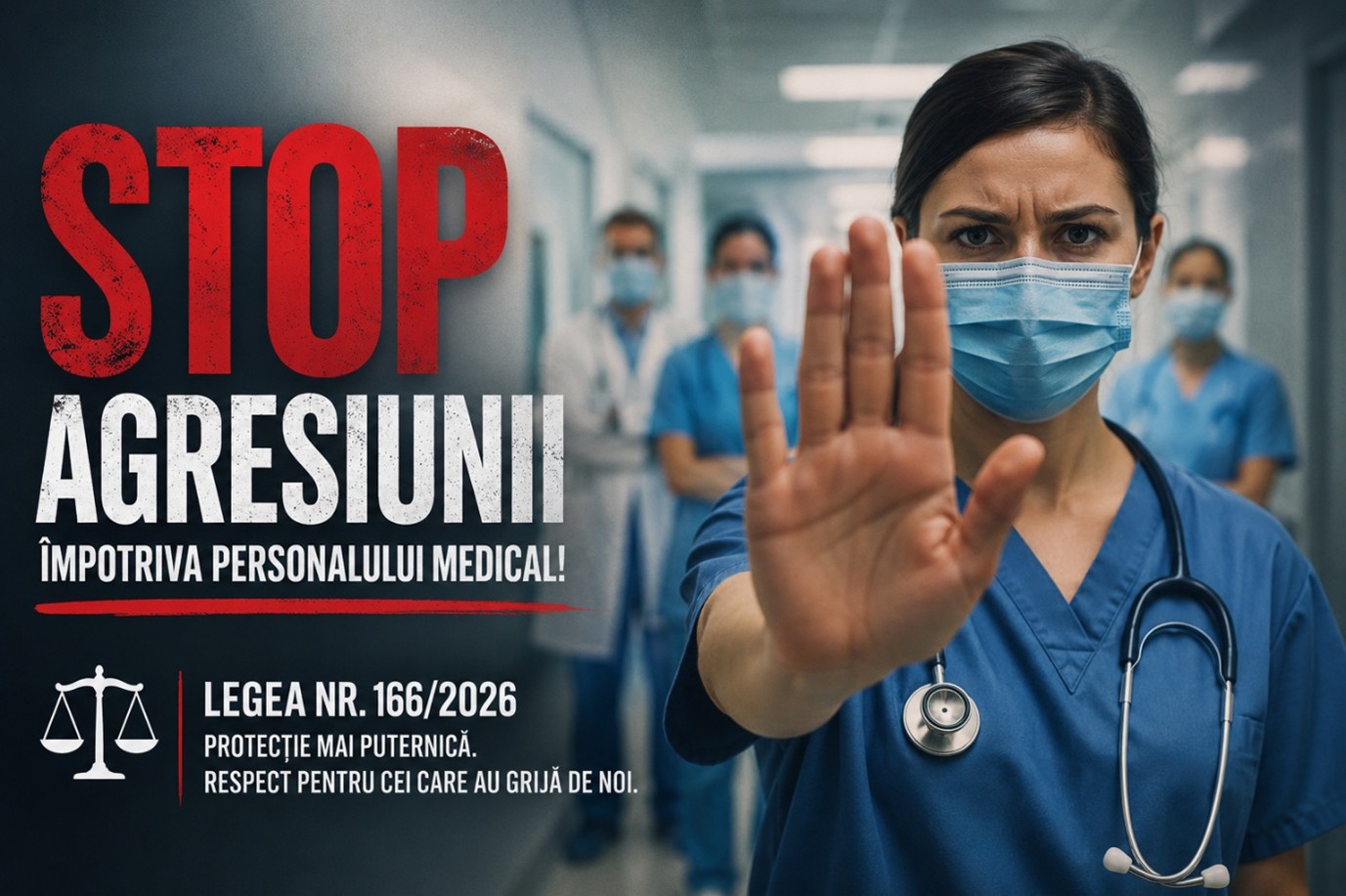
Doctors, nurses, auxiliary healthcare staff and non-medical staff in healthcare facilities will from now on benefit from strengthened criminal-law protection against threats and acts of violence.
Violence cannot become “part of the job”
In a healthcare system in which staff often work under pressure, in difficult conditions and with a high level of responsibility, assaults, threats and violence against medical staff are a problem that can no longer be treated as a mere occupational risk.
A doctor, a nurse, a healthcare assistant, a hospital porter or even a non-medical hospital employee must be able to perform their duties without fear that the dissatisfaction of a service user, patient, relative or any other person might turn into a threat or an act of violence.
In this context, Law No 166/2026, which entered into force on 8 August 2026, makes an important amendment to Law No 95/2006 on healthcare reform by strengthening the legal protection afforded to staff in healthcare facilities.
The legislature’s message is clear: assaults on medical staff must not be normalised, and working in healthcare must not mean accepting violence.
Who is protected by Law No 166/2026?
One of the most important changes concerns the very category of protected persons.
The new rules apply not only to doctors and other medical professionals, but also to auxiliary healthcare staff and non-medical staff working in public or private healthcare facilities.
The law applies regardless of the form in which the profession is practised, with protection covering persons acting in the performance of their duties and persons against whom offences are committed on account of acts carried out in the performance of those duties.
Accordingly, the legal protection of medical staff is extended to those employees who, although not practising a medical profession as such, contribute to the functioning of a healthcare facility.
This is a justified legislative solution, given that a violent incident in a hospital is not necessarily confined to the relationship between doctor and patient. In practice, assaults may target any employee performing their duties.

Threatening medical staff
is a criminal offence
The first situation expressly regulated is threats against medical, auxiliary healthcare or non-medical staff protected by the law.
Under the new Article 652(1) of Law No 95/2006, a threat made in person or by means of direct communication is punishable by imprisonment from 6 months to 2 years or by a fine where the act is directed against protected persons and is connected with the performance of their duties.
This provision is relevant given that threats addressed to medical staff are sometimes played down and regarded as mere expressions of anger or dissatisfaction.
From a legal standpoint, however, the specific content of the conduct and all the circumstances in which it occurred must be examined. Where the conditions laid down by law are met, a threat may give rise to criminal liability.
Assaulting a doctor or a nurse can carry up to 5 years’ imprisonment
Where a verbal conflict escalates into physical violence, the penalties are more severe.
Assault or other acts of violence committed against protected staff are punishable by imprisonment from 1 to 5 years.
Accordingly, assaulting a doctor, a nurse or another employee protected by Article 652 of Law No 95/2006 may give rise to significant criminal liability, if the legal conditions are met.
It is important to emphasise that protection does not only cover situations in which the assault takes place inside a hospital. The legal text also refers to offences committed on account of acts carried out in the performance of duties.

When the assault has serious consequences
Law No 166/2026 lays down progressive penalties according to the gravity of the offence and its consequences.
For bodily harm, the penalty is imprisonment from 2 to 7 years.
For assault or bodily harm causing death, the penalty range is 5 to 15 years’ imprisonment.
For murder, the penalty under the new Article 652 is imprisonment from 15 to 25 years.
We therefore have a set of rules that treats the various forms of violence differently, from threats to the most serious offences against life and bodily integrity.
Protection also extends to family members
An important new feature of Law No 166/2026 is the protection granted, under certain conditions, to family members of protected staff as well.
Under paragraph (6) of Article 652, the same penalties apply to the offences referred to in the preceding paragraphs where they concern a family member of the protected persons.
This legislative solution is relevant because a person seeking to put pressure on a doctor, a nurse or another employee of a healthcare facility may, in certain situations, try to direct their conduct against that person’s family.
The new rules recognise this form of vulnerability too and bring it within the scope of special criminal-law protection.
What does the new law mean for hospitals and other healthcare facilities?
The entry into force of Law No 166/2026 is not merely a change to certain penalty limits.
For hospitals, clinics, medical centres and other healthcare facilities, the new legal framework is also a reason to reassess how incidents of assault against staff are prevented and managed.
It is important for healthcare facilities to have clear procedures on:
In this context, the legal protection of medical staff must also be backed by an effective internal mechanism for preventing and managing violence in hospitals.
What should medical staff do if they are assaulted?
In the event of a threat or assault, the first step is, of course, to ensure the person’s safety and, where necessary, to call for the intervention of the competent authorities.
After that, it is important for the incident to be documented as rigorously as possible.
Depending on the situation, surveillance camera recordings, witness statements, medical documents, the messages or communications in which the threats were made and any other elements that may help to establish the facts may all be relevant.
For medical staff who have been assaulted, proper documentation may be essential for establishing the circumstances of the offence and for taking the necessary legal steps.
Criminal-law protection does not mean that every conflict is an offence
Although the new rules strengthen the protection of medical staff, this does not mean that every dispute or expression of dissatisfaction towards an employee of a healthcare facility automatically constitutes a criminal offence.
In each case, the specific circumstances, the nature of the conduct, the content of the threats or acts of violence, the link between the act and the performance of duties and the other conditions laid down by law must be examined.
A clear distinction is therefore needed between dissatisfaction, verbal conflict, inappropriate behaviour and a criminal offence.
The new law does not create privileges for medical staff; it offers additional legal protection against conduct that affects the integrity, safety and, in extreme cases, even the lives of those who work in the healthcare system.
A clear message: respect for those who care for us
Law No 166/2026 is an important step in strengthening the protection of medical staff and of other employees in healthcare facilities.
A functioning healthcare system cannot exist without doctors, nurses, auxiliary staff and non-medical staff who are able to work in safe conditions.
STOP assaults on medical staff!
Threatening a doctor, assaulting a nurse, violence against auxiliary staff or attacking an employee of a healthcare facility must not be treated as mere unavoidable incidents of hospital life.
By amending Article 652 of Law No 95/2006, the legislature sends a firm message: those who work in healthcare have the right to practise their profession without fear, and violence against medical staff has legal consequences.
For healthcare facilities, the next step is to ensure that this statutory protection is matched by effective internal procedures, measures to prevent assaults and a rapid, documented response to every incident.
Author: P.A.
Copyright © 2026. All rights reserved.
