03/09/2026
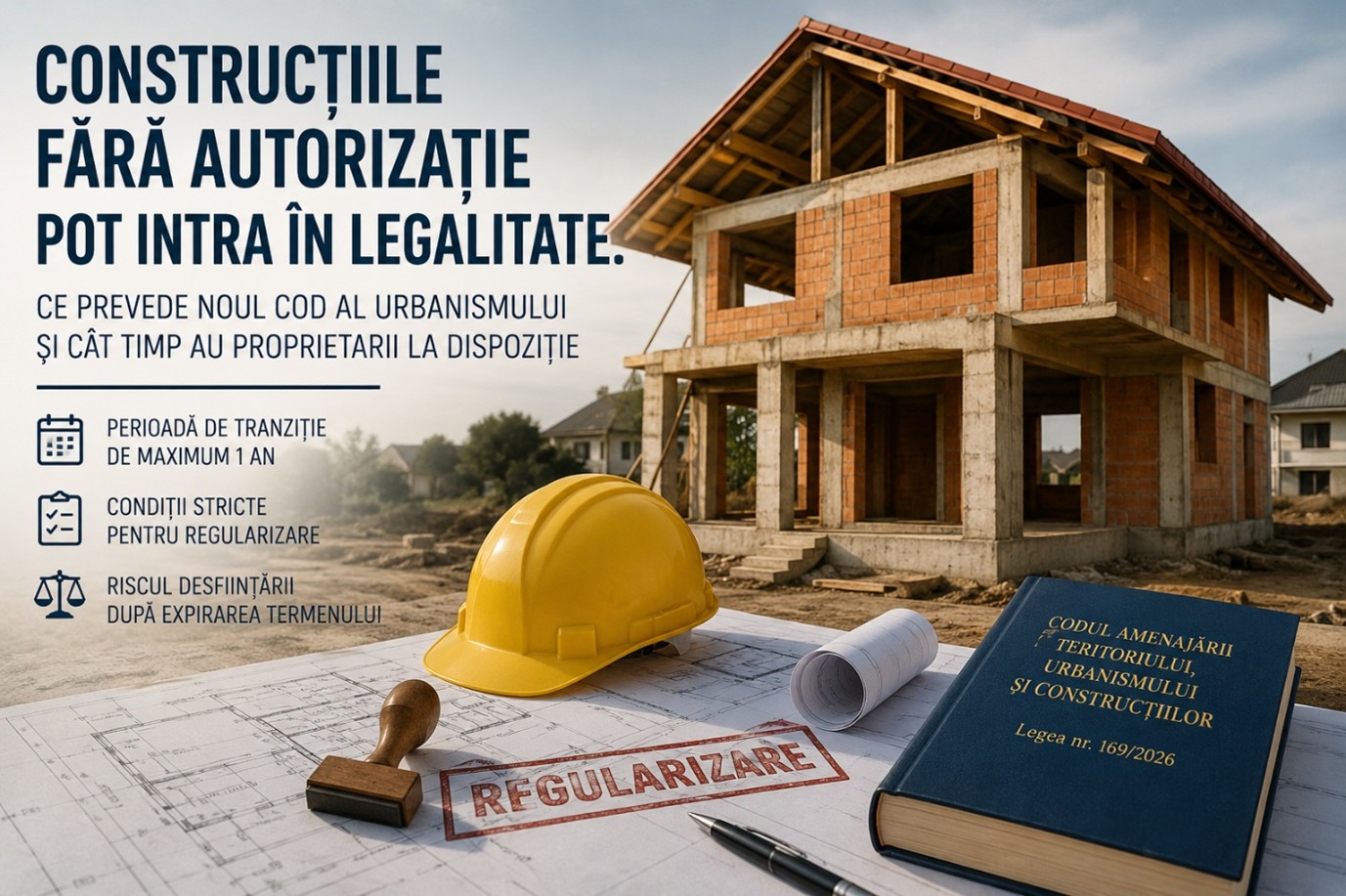
The new mechanism must not therefore be confused with a simple administrative procedure for 'registering' an existing building.
One of the most significant changes is the introduction of the regularisation permit, whereby certain buildings that have already been erected can be brought into legal compliance.
However, the new rules must be read carefully. The new Code does not establish a general procedure whereby any unauthorised building can be “legalised”; rather, it sets strict conditions, as well as a transitional period of up to one year during which regularisation may also be requested for categories of buildings that will no longer be eligible for this procedure afterwards.
What exactly is the
regularisation permit?
Under Article 301(1) of the Code, where works have been carried out in breach of the building permit or without one, the person responsible for the works is required to apply for a regularisation permit from the public administration authority competent to issue the building permit.
The new mechanism must not therefore be confused with a simple administrative procedure for “registering” an existing building.
Regularisation involves reviewing the building already erected in terms of compliance with planning law, construction quality requirements and the other conditions laid down by law.
A regularisation permit does not automatically turn an illegal building into a legal one.
On the contrary, the authority must verify whether the property can be retained and brought into line with the applicable regulations.
Which buildings are eligible for a regularisation permit?
The permanent rule laid down in Article 301(2) is a restrictive one.
Once the transitional period has expired, a regularisation permit may be issued for the following categories:
For single-family homes there is also an important additional condition: they must not be listed historic monuments, nor may they be located within the protection zones of historic monuments or in protected built-up areas.
Accordingly, the fact that a building is old, or that the authorities have tolerated it for a certain period, is not in itself sufficient for regularisation.
The conditions must be met cumulatively
Perhaps the most important aspect of the new rules is that falling within an eligible category of building is not enough.
Article 301 makes the issue of a regularisation permit conditional on several requirements being met cumulatively.
First, the building must comply with the applicable planning regulations.
Second, it must meet the fundamental requirements regarding construction quality.
The requirements imposed by environmental protection legislation and, where applicable, any other legal requirements must also be complied with.
Consequently, a regularisation permit cannot be obtained merely by presenting the existing building and a set of cadastral documents.
The building must also be justifiable from a planning and technical perspective.

How is the safety of the building verified?
One of the key differences from the simplistic notion of “getting legal” is the verification of the fundamental quality requirements.
To this end, the Code provides for verification by means of technical assessments prepared by certified technical experts, for the relevant fields and specialisms.
These cover, among other things:
This stage is essential because the regularisation permit cannot be used to retain buildings that, from a technical standpoint, do not offer the guarantees required for their use.
What happens if alterations are needed?
The new Code does not require the authority to choose immediately between full regularisation and demolition.
Where non-conformities can be remedied, the local public authority may require works to bring the building into compliance with the planning regulations and/or the technical regulations on construction quality.
In certain cases, the solution may even involve the partial demolition of some elements of the building.
The logic of the rules is therefore a gradual one:
verification → compliance → regularisation, where the building can lawfully be retained.
If the non-conformities cannot be remedied, the outcome is demolition.
The key novelty: the one-year period
For owners of buildings that do not fall within the categories set out in Article 301(2), the Code establishes a transitional solution.
Under Article 301(7), for a period of up to one year from the entry into force of the Code, a regularisation permit may also be requested for other categories of buildings erected without a permit or in breach of one.
However, this option is subject to several conditions:
Since the Code entered into force on 25 August 2026, the one-year period should be treated as a transitional window that closes in August 2027.
This period is particularly important for buildings that exceed the limits laid down in Article 301(2) or that do not belong to the categories for which regularisation will remain permanently available.

Temporary regularisation is more expensive
The legislature sought to prevent regularisation from becoming a more advantageous alternative to obtaining a permit before works begin.
To that end, in the situations governed by Article 301(7), the fees for state control in the field of spatial planning, urban planning and construction are set at ten times the amount that would have been payable had the works been carried out lawfully.
Likewise, in such cases the fee for the urban planning certificate and the building permit fee are ten times the standard fees.
The transitional period is therefore not an “amnesty” for buildings, but an opportunity for regularisation that comes with a significant additional cost.
What happens if the owner does not regularise the building?
The consequences are not merely administrative.
For buildings erected without following the legal procedures and that have not been regularised, the Code also provides for a 100% increase in the building tax, from the date on which the competent local public authority establishes that the construction is unauthorised until the regularisation permit is obtained or the works are demolished.
It should be stressed that paying the increased tax does not bring the building into legal compliance.
In other words, paying fees and taxes does not replace the regularisation permit, nor does it remove liability for breaches of building discipline.
What happens once the one-year period has expired?
This is one of the most important practical consequences of the new rules.
Once the transitional period has expired, buildings that do not fall within the categories for which regularisation remains permanently available will no longer benefit from this general “window”.
Article 358 provides that the inspection body must order the appropriate measures depending on the situation of the building.
If the building does not comply with the approved planning regulations and/or does not meet the fundamental quality requirements, this may lead to the demolition of the works.
The Code also expressly provides for the demolition of works carried out without a permit after the expiry of the period set out in Article 301(7).
If the sanctioned person fails to comply with the measures ordered, the authority may refer the matter to the court so that it may order, as appropriate, that the works be brought into line with the permit, regularised or demolished.
Is the old idea that “after three years, the building is legal” disappearing?
One of the issues that requires very careful analysis in legal practice is how the new Code relates to the old mechanism based on the limitation period for administrative-offence liability.
The new Code substantially changes the perspective.
As regards action by the authorities for the demolition or regularisation of unauthorised works, Article 357(11) provides for a period of 10 years from the date on which the works were actually completed for bringing the action provided for in paragraph (10).
The mere passage of a certain period of time should therefore not be confused with obtaining a permit, nor with the automatic regularisation of the building.
For owners of older buildings, the analysis must be carried out separately, depending on the date of construction, the legal regime applicable at the time of building and the transitional provisions of the new Code.

The problem cannot be “solved”
through a legalising Zonal Urban Plan (P.U.Z.)
Another important aspect is the prohibition on using urban planning documentation as an indirect means of legalising unauthorised buildings.
The Code provides that urban planning documentation whose purpose is to legalise buildings erected without a building permit or in breach of its provisions may not be initiated or approved.
However, the Code expressly provides for an exception in the situation governed by Article 150(14).
This provision is important in practice because it rules out the approach, seen in the past, of attempting to amend planning regulations solely in order to retain a building that has already been unlawfully erected.
The problem cannot be “solved”
through a legalising Zonal Urban Plan (P.U.Z.)
For owners in such a situation, the prudent approach is not to wait for deadlines to expire, but to check immediately whether regularisation is possible.
The title to the land, the cadastral situation and the status of the building must be checked.
It must be determined what has actually been built, when the works were carried out and to what extent they differ from any existing permits.
The planning regulations applicable to the land and the building must be verified.
It must be established whether the property falls within the category for which regularisation is permanently available or whether the one-year transitional period must be used.
Depending on the nature of the building, the necessary technical assessments must be carried out to demonstrate compliance with the fundamental quality requirements.
Regularisation does not remove tax obligations or the penalties applicable for carrying out works without a permit.
Only after these checks have been completed can a realistic assessment be made of whether the property can be retained and regularised.
Conclusion
The new Spatial Planning, Urban Planning and Construction Code fundamentally changes the regime applicable to buildings erected without a permit.
On the one hand, owners are given a concrete opportunity to bring existing buildings into legal compliance through the regularisation permit.
On the other hand, this opportunity is not unlimited.
For certain buildings, regularisation may be requested on a permanent basis, within the limits and under the conditions of Article 301(2). For the other categories, starting from 25 August 2026, there is a transitional period of up to one year.
Once it expires, the scope for regularisation narrows, and the authorities may order or seek the demolition of buildings that cannot be retained under the law.
The correct message of the new rules, therefore, is not that “the state is legalising buildings without a permit”, but that the legislature is offering a controlled regularisation procedure, accompanied by technical and planning checks, additional costs and a deadline for most buildings.
For owners of buildings without a permit, the coming period is therefore one in which verifying the legal and technical status of the property becomes all the more important.
Author: P.A.
Copyright © 2026. All rights reserved.
