05/10/2026
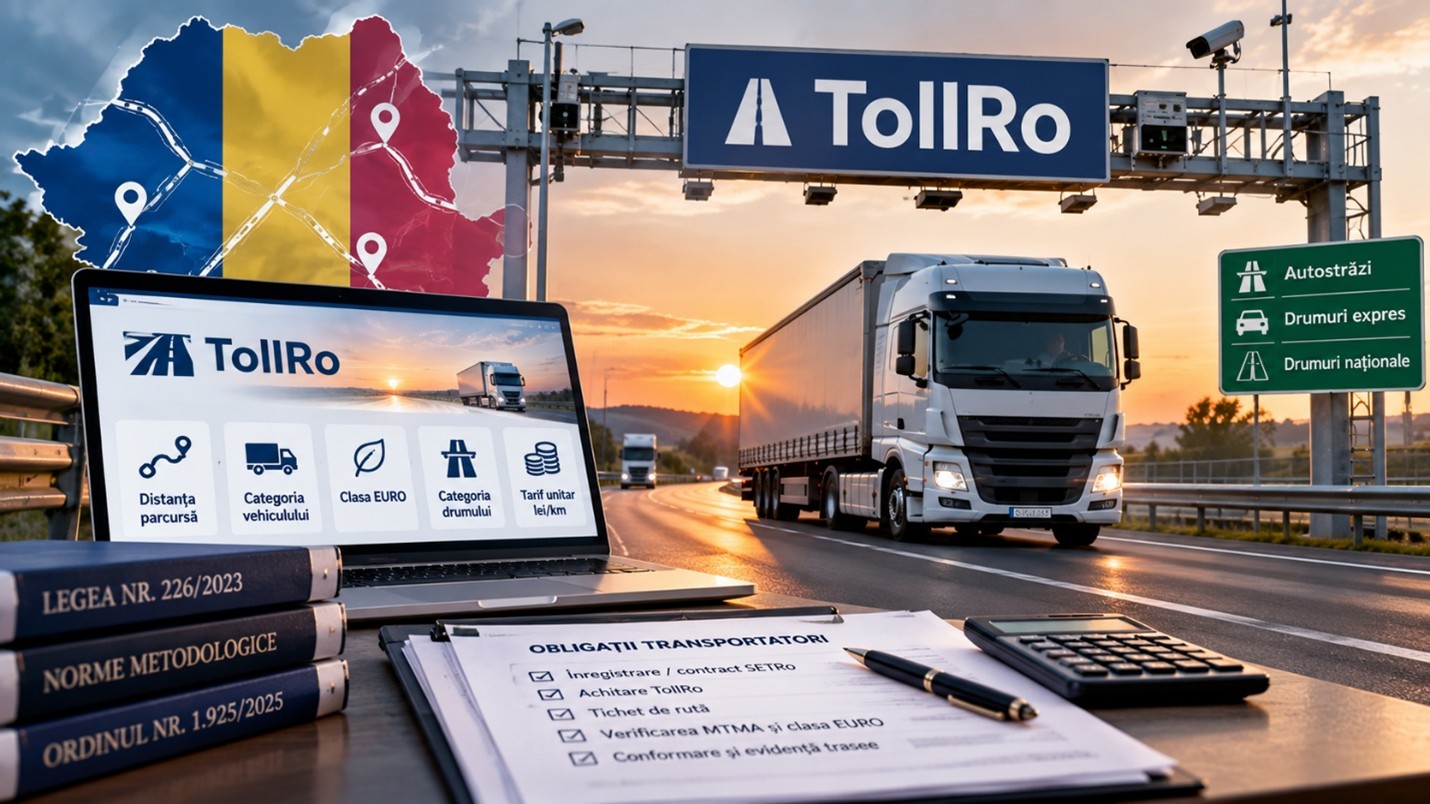
As of 1 October 2026, the new TollRo road charging system applies to goods vehicles with a maximum authorised mass (MAM) exceeding 3.5 tonnes.
TollRo is the toll payable for the use of the SETRE Romania network and, for these vehicle categories, replaces the previous time-based vignette (rovinietă) system. The system is based on the principle of charging according to the distance actually travelled, with the amount payable determined by multiplying the unit rate applicable to the vehicle and road category by the chargeable distance travelled.
Accordingly, the main change for hauliers is the shift from a system in which payment of the vignette conferred the right to use the network for a given period to a system in which, for trucks over 3.5 tonnes, the cost is linked to the kilometres actually charged.
The new TollRo system applies to registered vehicles that:
For TollRo purposes, mixed-use vehicles are treated as goods vehicles.
Companies should verify the MAM entered in the vehicle documents. For a combination consisting of a motor vehicle and one or more towed vehicles, the toll category is determined by reference to the sum of the MAMs entered in the registration documents of the motor vehicle and the towed vehicles. The user is liable for the accuracy of the declared category.
For goods vehicles with a MAM of 3.5 tonnes or less, the vignette system continues to apply under the conditions laid down in Law No 226/2023.
TollRo applies to the SETRE Romania network, namely the network of national roads, expressways and motorways managed by CNAIR (the National Company for the Administration of Road Infrastructure), with the exception of national road sections located within the built-up areas of municipalities, between the entry and exit signs.
Consequently, not every journey made within Romania automatically gives rise to a TollRo obligation – only the use of road sections forming part of the SETRE Romania network does.
TollRo is calculated by multiplying: the unit rate per km × the chargeable distance travelled.
The unit rate is set according to:
At the date the system entered into force, the unit rates approved by Order No 1925/2025 are as follows (VAT included):
| Category | MAM | Motorways and expressways – EURO VI / V-IV / III-0 | National roads – EURO VI / V-IV / III-0 |
|---|---|---|---|
| I | > 3.5 t and ≤ 7.5 t | RON 0.17 / 0.19 / 0.22 per km | RON 0.08 / 0.10 / 0.11 per km |
| II | > 7.5 t and < 12 t | RON 0.29 / 0.33 / 0.37 per km | RON 0.14 / 0.16 / 0.19 per km |
| III | ≥ 12 t | RON 0.48 / 0.55 / 0.62 per km | RON 0.24 / 0.28 / 0.31 per km |
The unit rate varies according to the EURO standard, so that vehicles in less favourable emission classes pay a higher rate. The rates are laid down in Order No 1925/2025 and are updated annually in line with the consumer price index.
Under Law No 226/2023, TollRo may be paid in three main ways:
According to information published by CNAIR, access through SETRo providers is scheduled to begin on 15 January 2027.
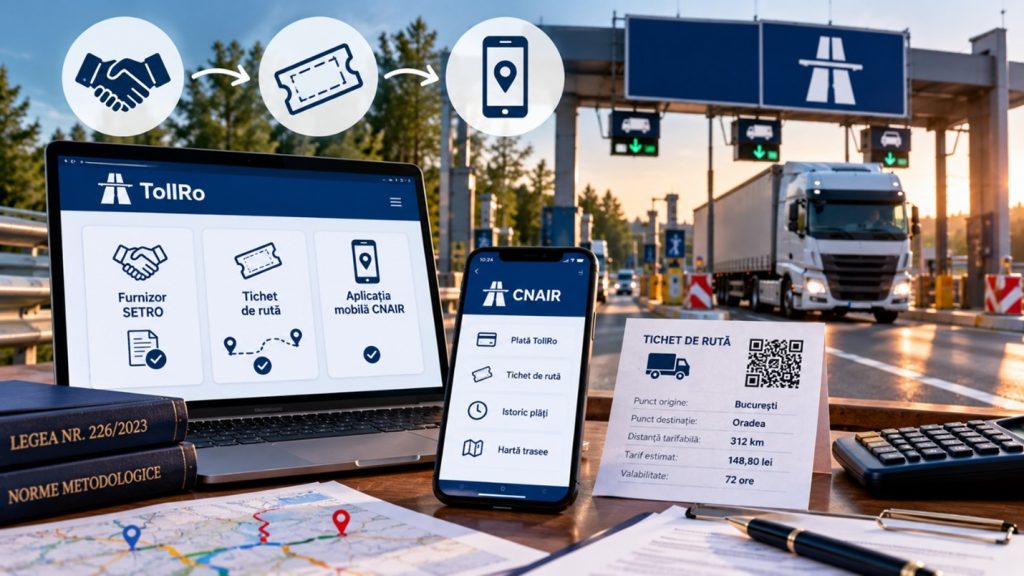
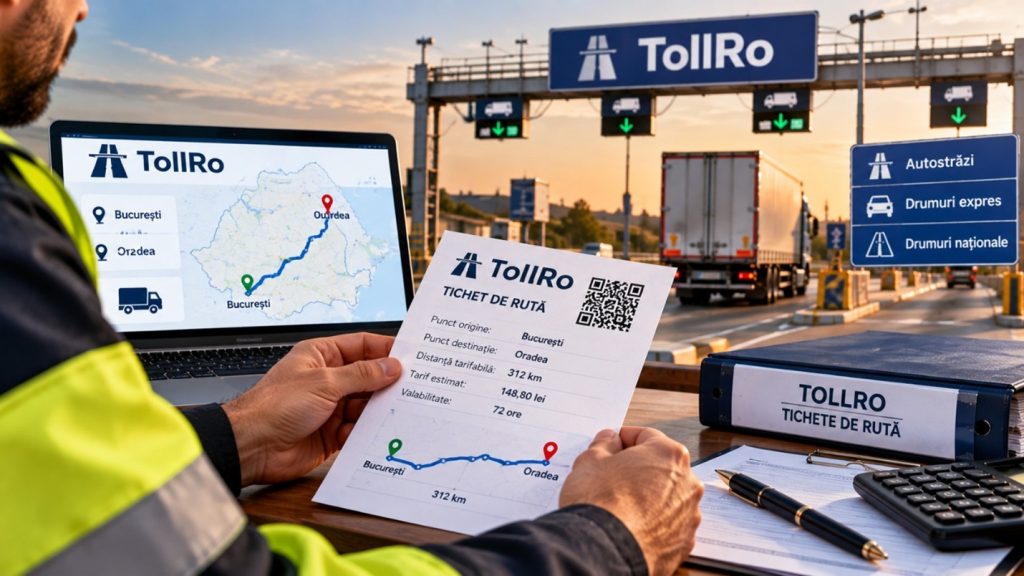
The route ticket is one of the methods of paying TollRo and should be understood as a document relating to an individual journey.
Under Article 10 of the Implementing Rules:
It is essential to emphasise that the 72-hour validity period does not turn the ticket into a “season pass” for that route.
Attention must also be paid to the direction of travel: a ticket for a passage along the declared route should not be treated as automatically covering a subsequent journey in the opposite direction.
The CNAIR mobile application uses the mobile device’s satellite positioning function to determine the road sections used and the chargeable distance, for the purpose of calculating and collecting TollRo.
The user must:
When the mobile application is used, TollRo is determined on the basis of the data actually collected and transmitted by the application, including the chargeable distance.
For hauliers making repeated daily trips, this method should be considered separately from the route ticket, as it does not require purchasing a ticket in advance for each journey.
The user is responsible for the accuracy, correctness and currency of the data declared for the purpose of determining and paying TollRo. The data used to calculate the toll must correspond to the actual situation of the vehicle and the configuration in which it is used on the SETRE Romania network.
To this end, the following information must be checked carefully:
Particular attention must be paid to situations involving changes to the configuration of the vehicle or combination, as these may lead to a change in the toll category and, consequently, in the amount of TollRo payable.
Accordingly, transport operators should put in place internal procedures to ensure that this data is checked and updated whenever a relevant change occurs. Failure to declare, or incorrect declaration of, vehicle parameters may result in TollRo being determined incorrectly and in additional payment obligations, as well as, where applicable, the penalties provided for by the legislation in force.
Under the Implementing Rules, in the event of a malfunction of the STRR (the road tolling system) or of the automated control equipment, vehicles that, at the time the malfunction occurs, have:
are not recorded in the STRR as being in a state of non-payment of TollRo for the period concerned.
The corresponding TollRo may be determined subsequently on the basis of the available data. CNAIR is required to inform users of the existence and duration of any such malfunction.
However, this rule should not be interpreted as a general exemption from the obligation to pay. In practical terms, it is essential that the haulier can demonstrate that, at the time the malfunction occurred, a lawful charging method was active.
Non-payment of TollRo constitutes an administrative offence under Law No 226/2023. For vehicles registered in an EU Member State, where non-payment is detected by automated means, the vehicle holder may receive an information letter regarding the non-payment and the obligation to pay the TollRo due.
The amount notified must be paid within 72 hours of receipt of the information letter. Payment within this period ends the non-payment and precludes the subsequent imposition of the administrative penalty for that non-payment.
Where the vehicle is stopped for inspection, the driver may be issued a payment notice, and the TollRo due must be paid on the spot by electronic means. If the driver refuses to pay, the enforcement officer may record the offence and impose the penalty provided for by law.
The fine for non-payment of TollRo is substantial. Where the distance travelled can be determined, the fine is set at between 10 and 20 times the amount of TollRo due. Where the distance cannot be determined, the fine is RON 5,000.
Hauliers holding vignettes purchased under the old system should check their validity period and the vehicle category.
As of 1 October 2026, vignettes issued under the old regime cease to be valid, except for those issued for vehicles to which the law continues to apply the vignette system, namely the vehicles referred to in Article 4(1) of Law No 226/2023.
Accordingly, for a truck with a MAM exceeding 3.5 tonnes, an old vignette can no longer be used after 1 October 2026 to cover the TollRo charging obligation.
In addition, for vignettes that ceased to be valid as a result of the switch to the new system, CNAIR refunds, at the user’s request, the amount corresponding to the unused period. Order No 922/2026 provides that the refund is calculated pro rata to the remaining unused period, by reference to the vignette’s total validity period, after deducting the transfer costs and the applicable fee. A refund is made only if the amount due exceeds these costs.
The introduction of TollRo represents a significant change to the legal and operational framework applicable to road freight transport in Romania.
For vehicles with a MAM exceeding 3.5 tonnes, the main change is the shift from a vignette based on the period of use to a system in which the amount payable is determined mainly by the vehicle category, the EURO class, the road category and the chargeable distance actually travelled.
In particular, it should be borne in mind that:
In view of the practical and financial implications of the new system, it is advisable to review each vehicle individually and implement an internal TollRo procedure, so that the legal obligations are integrated into the company’s day-to-day operations.
Author: SZ.I.
Copyright © 2026. All rights reserved.
