05/05/2026
Abstract: The rapid development of artificial intelligence (AI) systems is placing structural pressure on the traditional architecture of civil liability, which was designed in a context where the relationship between the act, the author and the damage was essentially direct and identifiable. The emergence of systems capable of autonomously processing massive volumes of data and generating decisions with significant legal or economic impact is relativising the classical concepts of fault, imputability and causation.
This paper sets out to analyse the extent to which the mechanisms established by the Romanian Civil Code can be used to cover damage caused by artificial intelligence, in the absence of a fully developed autonomous legal regime. In this context, it examines the main forms of civil liability – tortious, contractual and liability for things – in terms of their suitability for the technological specificities of AI, as well as their functional limits in situations characterised by algorithmic opacity and decision-making autonomy.
At the same time, the analysis seeks to identify the actors potentially liable along the chain of production and use of AI systems – developers, data providers, operators and digital intermediaries – highlighting the difficulty of delimiting the scope of liability within complex and interdependent technological ecosystems. In parallel, it assesses regulatory trends at European Union level, in particular with reference to the Artificial Intelligence Act, which proposes a risk-based approach and the introduction of differentiated obligations according to the impact of AI systems.
The institution of civil liability has traditionally been built on the premise of an act attributable to a specific person, within a legal relationship in which the author of the damage can be identified and their conduct assessed against criteria such as negligence or intent. This construct, enshrined and systematised in the Romanian Civil Code, presupposes a relatively clear relationship between the act, the author and the harmful consequence.
The emergence and rapid development of artificial intelligence systems, however, undermine this classical premise, bringing about a genuine paradigm shift. Thus, in the context of AI use:
In these circumstances, the main difficulty lies not in establishing that damage has occurred – which is often evident and quantifiable – but in identifying the legal subject to whom it can legitimately be attributed. The legal problem thus shifts from the analysis of individual conduct to the assessment of a distributed technological chain, involving developers, data providers, operators and users, each contributing in different ways to the final outcome.
This transformation calls for a reconsideration of the foundations of civil liability, by adapting the criteria for attribution and redefining the notion of legal control over technological tools, so as to preserve the essential function of this institution: full compensation for damage and effective protection of the injured party.
2.1. Tortious liability
The classical model of tortious liability, enshrined in the Romanian Civil Code, requires the cumulative fulfilment of well-defined conditions: the existence of an unlawful act, the occurrence of damage, a causal link between the act and the damage, and the fault of the author. This conceptual framework works effectively in the case of identifiable human conduct that can be assessed against standards of diligence and prudence.
In the field of artificial intelligence, however, applying these requirements runs into structural difficulties arising from the technological nature of the systems involved. First, fault becomes difficult to individualise, since the harmful decision can no longer be attributed to intent or negligence in the classical sense, but results from an autonomous algorithmic process that does not directly reflect a person’s state of mind. Even where a human actor (developer, operator) can be identified, the link between their conduct and the outcome produced by the AI is often indirect and technologically mediated.
Second, proof of the causal link is profoundly affected by algorithmic opacity. “Black box” systems limit access to the internal decision-making logic, making it difficult to demonstrate that a particular harmful outcome is the direct consequence of a specific error or defect. Without sufficient transparency, the causation analysis risks remaining at a probabilistic level that is, in some situations, incompatible with traditional standards of proof.
Finally, technical expert evidence becomes indispensable, yet not always conclusive. The complexity of AI models, their dynamic nature and their dependence on large volumes of data may lead to diverging opinions or make it impossible to reach firm conclusions, which undermines the predictability of judicial outcomes.
In these circumstances, although tortious liability remains applicable in principle and provides a theoretical framework for establishing liability, its effectiveness is diminished from an evidentiary standpoint. It tends to become a difficult instrument to use in practice, absent legislative or case-law adaptations that take account of the particularities of AI technology.
2.2. Liability for things
Extending the notion of a “thing”, as understood under the Romanian Civil Code, makes it possible to bring artificial intelligence systems within the scope of liability for things, through an evolutive interpretation adapted to technological realities. In this framework, the basis of liability is no longer fault, but legal custody of the thing, understood as the power of direction, control and use in one’s own interest.
Liability therefore lies with the person exercising such legal custody, usually the user or operator of the AI system, regardless of proof of fault. The focus shifts significantly from the analysis of subjective conduct to the objective relationship between the person and the technological tool, as well as to the benefit that person derives from using the system. This approach meets a need for practical effectiveness, facilitating compensation simply by proving the link between the thing and the occurrence of the damage.
The main advantage of this solution lies in its pragmatic and functional nature; it is already recognised in legal scholarship and reflected, implicitly or explicitly, in case law as a mechanism for adapting classical law to new technologies. It makes it possible to avoid the evidentiary difficulties specific to tortious liability, particularly as regards fault and, in part, causation.
Nevertheless, this construct has obvious limits. First, it tends to oversimplify the technological reality, reducing the complexity of the AI ecosystem to a binary relationship between the “thing” and its “custodian”. Second, it ignores or marginalises the contribution of other key actors, such as developers or data providers, whose decisions may decisively influence the behaviour of the system. Consequently, placing liability entirely on the user may lead to unfair outcomes, especially where the user has no effective control over the internal mechanisms of the AI.
Therefore, although liability for things is currently one of the most viable solutions under positive law, it is provisional in nature and requires legislative additions reflecting the distributed nature of the risks associated with artificial intelligence.
2.3. Contractual liability
In contractual relationships, the use of artificial intelligence systems does not, in principle, entail any derogation from the general rules on contractual liability laid down in the Romanian Civil Code. On the contrary, the classical mechanisms remain applicable, even when faced with new technical situations.
Thus, a party that uses an AI system to perform its obligations cannot escape liability by invoking the system’s autonomy or unpredictability. From a legal standpoint, artificial intelligence is treated as a means of performance, similar to other technical or human means, and its selection and use fall within the debtor’s sphere of control and responsibility. Any shortcomings of the system, malfunctions or non-conforming results are therefore attributable to the party that integrated it into the contractual performance.
In the event of non-performance or defective performance, classical contractual liability is triggered, with all its consequences: the obligation to make good the damage, possibly the payment of damages and, where appropriate, other specific remedies (termination, price reduction, etc.). From this perspective, AI is not a ground for exemption, absent circumstances amounting to force majeure or other legal grounds for exemption – conditions that are difficult to meet when using technological systems whose risks are foreseeable.
Therefore, at contractual level, artificial intelligence is treated as a tool under the debtor’s control, and the risks inherent in its use are absorbed into the obligations undertaken. This solution ensures the stability and predictability of legal relationships, but significantly shifts the technological risk onto the party using AI, which may, in certain situations, call for contractual mechanisms to allocate that risk (limitation-of-liability clauses, warranties, insurance, etc.).
3.1. The developer
In the legal architecture of liability for damage caused by artificial intelligence, the developer occupies a central position, insofar as it designs, trains and configures the system, setting the initial parameters of its operation. From this perspective, its liability may be engaged for a range of shortcomings relating to the design and technical implementation phase.
The developer may thus be liable for:
Legally, the developer’s position is often analysed by analogy with the regime of liability for defective products, enshrined in the Romanian Civil Code and in special legislation. This analogy makes it possible to ground liability independently of proven fault, by reference to the lack of the safety that the user or the public is legitimately entitled to expect.
However, the analogy has significant limits. Unlike conventional products, AI systems are not static entities but dynamic systems, capable of evolving after being placed on the market through continuous learning mechanisms. This feature makes it difficult to pinpoint the moment at which the product may be considered “defective”, and to attribute exclusive liability to the developer for emergent behaviour that was not foreseeable at the design stage.
Consequently, although the developer remains a key actor in the configuration of civil liability, its liability must be established within a more nuanced framework that takes account of the evolving nature of AI systems and their interdependence with the other participants in the technological chain.
3.2. The user / operator
In practice, the user or operator of the artificial intelligence system emerges as the main candidate for civil liability, given its functional position in the chain of use of the technology. This orientation is driven by several legally relevant factors.
First, the user exercises immediate control over the system, being the one who activates it, configures its operational parameters and integrates it into a particular decision-making or business process. Second, the user determines the specific context of use, including the purpose, limits and conditions under which the AI is used – all essential for risk assessment. Last but not least, the user is usually in a position to prevent or limit the occurrence of damage, whether through supervision, human intervention or the choice of systems appropriate to the level of risk.
For these reasons, placing liability on the user appears to be an effective solution consistent with the logic of civil law, including through the concept of legal custody of a thing under the Romanian Civil Code. It allows a liable party to be identified quickly and facilitates compensation.
Nevertheless, this solution is not without criticism. In certain situations, the user has no real control over the internal mechanisms of the AI system, especially in the case of complex, opaque technologies or those provided “as a service” (AI as a Service). The system’s decision-making autonomy, combined with the lack of access to the algorithmic logic, may turn the user into a mere technological intermediary, without any real ability to anticipate or influence the results.
In these circumstances, placing liability entirely on the user risks leading to unfair outcomes, by transferring a disproportionate technological risk to a person who does not substantially control the cause of the damage. Looking ahead, this reality calls for a reconfiguration of the criteria for attribution, towards a more balanced distribution of liability among the actors involved.
3.3. Data providers
In the artificial intelligence ecosystem, data providers play an essential role that is often underestimated from a legal perspective, even though data are the raw material on which AI systems are trained and base their decisions. The quality, accuracy and representativeness of these data directly influence algorithmic behaviour, and may lead to compliant or, conversely, harmful results.
Thus, bias or errors in the datasets can have significant negative consequences, including discrimination, incorrect decisions or flawed assessments in sensitive contexts (financial, medical, legal). In such situations, the damage does not necessarily result from a technical malfunction of the system, but from a structural deficiency in the data used, which distorts the AI’s decision-making logic.
Nevertheless, establishing the liability of data providers is particularly difficult. The main problem lies in the complexity of the causal chain, since data are usually:
In these circumstances, establishing a direct link between a particular data deficiency and the damage caused becomes problematic, both evidentially and conceptually. Moreover, data providers usually have no control over how the data are subsequently used by developers or operators, which complicates the assessment of imputability.
Therefore, although data providers may make a decisive contribution to the occurrence of damage, the current legal framework, including that derived from the Romanian Civil Code, does not provide sufficient tools to readily establish their liability. This gap highlights the need for legislative mechanisms that explicitly recognise the role of data in generating risks and allow for a fairer distribution of liability along the technological chain.
3.4. Digital platforms
The role of digital platforms in the artificial intelligence ecosystem is evolving significantly, from the traditional position of a mere technical intermediary to that of an active player, with real influence over how AI systems operate and are used. This transformation has direct implications for the configuration of civil liability.
First, platforms exercise significant control over the access to and distribution of AI-based technologies, setting the conditions under which they are made available to users, as well as the rules of use. Through internal policies, terms and conditions or moderation mechanisms, they can directly influence the risks associated with the use of these systems.
Second, in many situations, platforms have the ability to intervene in the algorithms, whether through configuration, optimisation, updating or even suspension. This level of control goes beyond mere technical intermediation and brings platforms close to the position of a co-author or, at the very least, an active participant in the algorithmic decision-making process.
Against this background, a trend is emerging, particularly at European Union level, towards extending the liability of digital platforms, in line with their growing role and influence. Legislative initiatives and case-law trends seek to move beyond the classical model of intermediary exemption, in favour of an approach that takes into account the actual degree of control and involvement.
This development reflects a paradigm shift: platforms can no longer automatically invoke technological neutrality insofar as they actively participate in the configuration and operation of AI systems. Consequently, they become potential subjects of civil liability within a constantly evolving legal framework that seeks to adapt traditional principles to the realities of the digital economy.
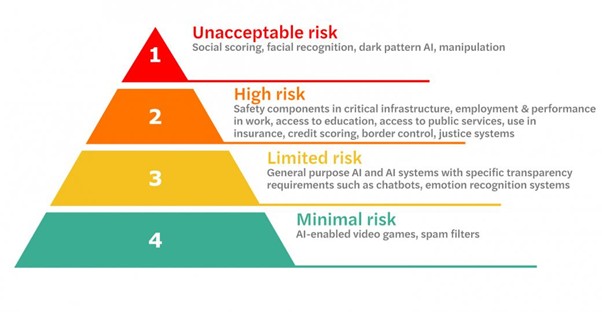
Through the Artificial Intelligence Act and related legislative initiatives, the European Union is shaping a complex regulatory framework aimed at managing the risks posed by AI systems and adapting legal mechanisms to their specific features. The European approach stands out for its preventive nature and its attempt to reconcile technological development with the requirements of legal protection.
A central element of this regulation is the classification of AI systems according to their level of risk, which allows differentiated legal regimes to apply. Thus, systems considered high-risk are subject to strict requirements regarding:
In this context, the aim is to introduce enhanced obligations for operators and developers of high-risk AI systems, designed to reduce the likelihood of damage and to facilitate the identification of causes in the event of incidents.
Likewise, a key objective of the European framework is to facilitate access to evidence for injured parties, in order to overcome the difficulties caused by algorithmic opacity. To this end, mechanisms are envisaged to allow access to relevant information on how AI systems operate, including through documentation and transparency obligations imposed on operators.
At the same time, the European Union seeks to strike a balance between fostering innovation and protecting fundamental rights, avoiding both over-regulation and leaving technologies with a significant impact on society unchecked.
As regards civil liability, current debates also address the introduction of forms of strict liability for certain categories of AI systems, in particular high-risk ones, as well as a possible reversal of the burden of proof in favour of the victim. These solutions would represent a substantial adaptation of classical principles, with a view to ensuring effective protection and a fair distribution of technological risks.
5.1. Causation
One of the pillars of civil liability is the existence of a certain and direct causal link between the act and the damage. In the case of artificial intelligence systems, this requirement is profoundly affected by the technological structure of the decision-making process. The causal chain is no longer linear, but fragmented and distributed among several actors and stages (data collection, model training, deployment, actual use).
Consequently, establishing a direct relationship between particular conduct and the resulting damage becomes difficult, and sometimes impossible in the traditional terms of legal proof. This reality calls into question the adequacy of the classical criteria of the Romanian Civil Code, which require a sufficiently clear causal link for liability to arise.
5.2. Algorithmic opacity
Many AI systems operate on the basis of complex models characterised by a high degree of decision-making opacity (“black box”). This lack of transparency limits access to the internal logic of the algorithm and makes it difficult to reconstruct the reasoning that led to a particular result.
From a legal perspective, opacity affects not only the causation analysis but also the right to a fair trial, as the injured party may be unable to understand and effectively challenge the mechanism that caused the damage. In the absence of transparency and explainability obligations, an evidentiary imbalance arises between the parties.
5.3. Technological autonomy
As AI systems become increasingly autonomous, their capacity to generate results without direct human intervention raises fundamental issues of imputability. The classical model of civil liability is based on the idea that damage can be attributed to a person who culpably acted or failed to act.
In the case of AI, however, the decision is the result of an autonomous process, which dilutes the link between human will and the outcome produced. In these circumstances, the traditional criteria for attribution (negligence, intent) become insufficient and need to be reconfigured in light of the new technological realities.
5.4. The dispersion of responsibility
The AI ecosystem involves a plurality of actors – developers, data providers, operators, platforms – each contributing in different ways to the operation of the system. This multiplicity of participants leads to a dispersion of responsibility in which no single actor has exclusive control over the final outcome.
The major risk is a dilution of liability, where the difficulty of identifying a clearly liable party directly undermines the victim’s right to compensation. Without legal mechanisms for the coherent allocation of liability, technological complexity may become an obstacle to the effective protection of injured parties.
An analysis of the limits of the current legal framework highlights the need for legislative intervention to adapt the institutions of civil liability to the technological specificities of artificial intelligence. In this respect, several directions for reform are emerging, designed to ensure both effective protection of injured parties and a climate favourable to innovation.
A first direction concerns the introduction of a form of strict liability for high-risk AI systems, in line with the approach of the Artificial Intelligence Act. Such a solution would remove the need to prove fault, focusing the analysis on the existence of damage and its link with the operation of the system, which would facilitate victims’ access to redress.
Closely related to this is the need for compulsory insurance for operators of AI systems, in particular those with a significant impact. A compulsory insurance mechanism would allow technological risks to be spread and would guarantee the availability of financial resources to cover damage, reducing dependence on identifying a particular liable party and on its solvency.
Another essential direction is the development of mechanisms for reversing or easing the burden of proof, designed to correct the evidentiary imbalance created by algorithmic opacity. Where the victim cannot access the relevant technical information, it would be justified to introduce presumptions in their favour or to require operators to provide evidence of the system’s compliance.
Likewise, there is a need to establish mandatory standards of transparency and algorithmic auditing, allowing the operation of AI systems to be verified and any deficiencies to be identified. These standards should include documentation, traceability and explainability obligations, to facilitate legal and technical oversight.
Last but not least, there is a need for a clear allocation of responsibilities among the actors involved – developers, data providers, operators and platforms – through explicit regulation of the role of each in the technological chain. Such clarification would help avoid the dilution of liability and ensure a fair distribution of risks.
Taken together, these reform directions outline a transition from a classical, fault-based model to a model adapted to technological risks, with the emphasis on prevention, risk distribution and the effective protection of the victim.
Current civil law undoubtedly offers solutions applicable to damage caused by artificial intelligence, in particular through the mechanisms of the Romanian Civil Code relating to liability for things and contractual liability. In practice, these instruments make it possible to identify a liable party and ensure that the damage is made good, even in the absence of a specialised regulatory framework.
Nevertheless, the existing solutions are essentially adaptations of traditional legal concepts to new technological realities, rather than a systemic, coherent and comprehensive response. They operate by extension and analogy, which inevitably makes them fragmentary and, at times, unpredictable.
In this context, artificial intelligence calls for a profound rethinking of the foundations of civil liability around clear guiding principles. First, protection of the victim must remain central, so that technical difficulties or the complexity of AI systems do not become an obstacle to compensation. Second, there must be a fair distribution of technological risk among the actors involved, avoiding both an excessive concentration of liability on a single participant (usually the user) and its dilution to the point of ineffectiveness. Finally, the legal framework must strike an appropriate balance between encouraging innovation and maintaining an adequate level of accountability, so that technological development is neither stifled nor left without legal consequences.
In the absence of coherent legislative intervention, aligned also with European developments, practice will continue to operate through conceptual extensions and ad hoc case-law solutions, with the risk of inconsistent interpretations and reduced legal predictability. In these circumstances, a regulatory framework tailored to the specificities of artificial intelligence becomes not merely desirable but essential for maintaining the balance between technology and law.
Author: P.A.
Copyright © 2026. All rights reserved.
We use cookies that are strictly necessary for the website to work and, only with your consent, statistics cookies (Google Analytics) that show us how the website is used. You can change your choice at any time under “Cookie settings”.
