14/05/2026

The hybrid working model has undoubtedly become the dominant way of organising work in many fields. From private companies and public institutions to the IT sector, consultancy and administrative services, alternating between work at the employer’s premises and remote work is now perceived as the norm on the labour market.
The image of the teleworker working from a sunny beach, a café or the middle of nature, with nothing but a laptop and an internet connection, has become the informal symbol of the freedom promised by the digitalisation of employment relationships. In reality, however, the flexibility offered by telework does not suspend the employer’s legal obligations, nor does it turn any space into a safe workplace that complies with legal requirements.
On the contrary, hybrid work raises some of the most complex current legal issues in employment law, occupational health and safety, data protection and the organisation of working time. In practice, many employers implement hybrid arrangements informally, without appropriate addenda, without coherent internal policies and without any real assessment of the risks associated with remote work.
but absent from legislation
Although the expression “hybrid work” is used almost daily in employment practice, it is not expressly defined in employment legislation. From a legal standpoint, what we informally call “hybrid work” is in fact a form of telework in which the work is not performed exclusively remotely, but alternately, both at the employer’s premises and in other locations.
The applicable legal regime derives mainly from Law No 81/2018 on the regulation of telework, supplemented by the provisions of the Labour Code and, where applicable, the Administrative Code.
The Telework Law lays down two essential elements that turn an individual employment contract into a telework contract:
– the work is performed in a place other than the one organised by the employer;
– information and communication technology is used.
The two conditions must be assessed together. Merely using a laptop or digital work platforms is not sufficient for telework to exist, just as performing work somewhere other than the employer’s premises does not automatically give rise to a telework relationship.
Moreover, Law No 81/2018 expressly requires that the telework nature of the work be stated in the individual employment contract. In other words, informal telework is not lawful, even though it is frequently tolerated in practice.
This practice gives rise to significant legal risks, including administrative fines. Under the legislation in force, the absence of the mandatory telework clauses may result in fines of up to RON 10,000 for each person found to be in this situation.
nature of the “place of work”
One of the most significant errors encountered in practice is the perception that the flexibility of hybrid work allows the employer to change the conditions regarding office attendance at any time and unilaterally.
In reality, the “place of work” is an essential clause of the individual employment contract, and it cannot be changed unilaterally, except in the cases expressly provided for by law, such as business travel assignments (delegare) or secondment.
Law No 81/2018 expressly requires the telework contract to state the periods and/or days on which the teleworker works at a workplace organised by the employer. The purpose of this obligation is to ensure the predictability of the employment relationship and to prevent disputes.
In practice, however, many employers use vague wording such as:
– “office attendance as needed”;
– “flexible schedule set by the manager”;
– “call-in according to the company’s needs”.
Such wording may become problematic in the event of litigation, as it allows arbitrary interpretations and may lead to an unformalised change in the employment relationship.
It is not uncommon for employees to find that a hybrid arrangement initially negotiated as involving office attendance a few days a month gradually turns into an almost permanent obligation to be physically present, without any corresponding amendment to the individual employment contract.
Internal regulations cannot replace the individual employment contract and cannot unilaterally change the essential clauses negotiated between the parties. This is precisely why the alternation between telework and work at the employer’s premises must be set out clearly and predictably in the contract.

The Labour Code increasingly reflects the trend towards more flexible employment relationships, but this flexibility is not designed as a discretionary right of one of the parties; it is a mechanism for balancing the legitimate interests of the employer and the employee. In this context, Article 118 of the Labour Code governs the possibility of individualised working time arrangements, including through the use of remote working.
Under paragraph (7) of the same article, flexible organisation of working time means that the working schedule may be adapted, including through telework or other remote working arrangements. From this perspective, the legislature recognises that flexibility is no longer merely a benefit occasionally granted by the employer, but a legitimate component of the modern organisation of work.
In practice, this provision allows the employee to request an individualised schedule that includes telework or hybrid work. A key point, however, is that the employee’s request cannot be arbitrarily ignored. The Labour Code requires the employer, in the event of a refusal, to reply in writing, stating its reasons, within a time limit expressly laid down by law.
This obligation to state reasons is of major practical importance, as it limits the scope for formal or abusive refusals and requires the employer to justify specifically why the work cannot be organised flexibly. In the absence of an objective justification, the refusal may become a source of labour disputes, particularly where certain activities clearly allow remote work without affecting the employer’s business.
At the same time, the legal provisions seek to strike a balance between the employer’s organisational needs and the employee’s legitimate interest in reconciling professional and personal life. In recent years, flexible working hours and the possibility of working remotely have become key criteria for the stability and attractiveness of employment relationships, especially in fields where work can be digitalised.
Current legislation also grants additional protection to certain categories of employees. Thus, the Labour Code provides that employees with dependent children up to the age of 11 may work from home or telework for a limited number of days per month, under the conditions laid down by law.
This provision reflects the current direction of employment legislation towards supporting the balance between professional life and family responsibilities, without, however, turning telework into an absolute right of the employee. Even in these situations, the exercise of the right must be reconciled with the specific nature of the work and with the employer’s genuine organisational needs.
In practice, however, one of the most common problems remains the gap between contractually regulated flexibility and informally applied flexibility. Many employment relationships operate on the basis of unformalised arrangements regarding telework or office attendance, which can cause major difficulties in the event of disputes over working hours, time actually worked, disciplinary liability or occupational health and safety obligations.
One of the most widespread perceptions associated with telework is that a laptop and a stable internet connection are enough to turn any space into a suitable workplace. The image of the employee working from a café, an airport or even a beach has become, in recent years, the informal symbol of the absolute flexibility offered by the digitalisation of employment relationships.
From a legal perspective, however, this image oversimplifies the obligations that continue to apply in the field of occupational health and safety. The fact that work is performed at the employee’s home or in another location chosen by the employee does not reduce the employer’s obligations to ensure safe working conditions that comply with legal requirements.
The portability of a laptop does not mean that any space automatically becomes compatible with the rules on ergonomics and safety at work. In reality, many of the places from which teleworkers occasionally choose to work are unsuitable for carrying out professional activity in the medium or long term. Poor working postures, inadequate lighting, the lack of ergonomic furniture or the exclusive use of a laptop without additional equipment can create real risks to employees’ health.
In this context, Government Decision No 1028/2006 lays down a number of minimum requirements for work with display screen equipment, which also apply to teleworkers. The rules cover both the technical characteristics of the equipment used and the actual organisation of the workstation. They address matters such as:
– the characteristics and positioning of the screen;
– the adjustment and placement of equipment;
– the ergonomics of the keyboard and peripherals;
– the lighting of the workspace;
– body posture during work;
– sufficient space in which to work;
– the use of an ergonomic, adjustable chair.
These requirements are not mere theoretical recommendations, but minimum measures intended to prevent conditions caused by prolonged use of display screen equipment. Nevertheless, in practice, many telework relationships rely solely on a laptop placed makeshift on the kitchen table, on the sofa or even on the employee’s lap, without appropriate ergonomic conditions and without any real assessment of the associated risks.
The laptop is undoubtedly one of the most versatile tools of modern work, but this versatility does not automatically amount to a safe and healthy workstation. The small screen, the position of the keyboard and the impossibility of adjusting all components at the same time frequently lead to unsuitable working postures.
Without additional equipment – such as a separate keyboard, an external mouse, a screen stand, an ergonomic chair or adequate lighting – there are significant risks of developing musculoskeletal disorders, neck and lower back pain, eye strain or other problems associated with sedentary work and intensive use of technology.
The issue is all the more important given that, in many organisations, telework is viewed exclusively in terms of flexibility and reduced logistics costs, while the specific obligations regarding risk assessment, employee training and the actual adaptation of working conditions to the specific nature of remote work are ignored.
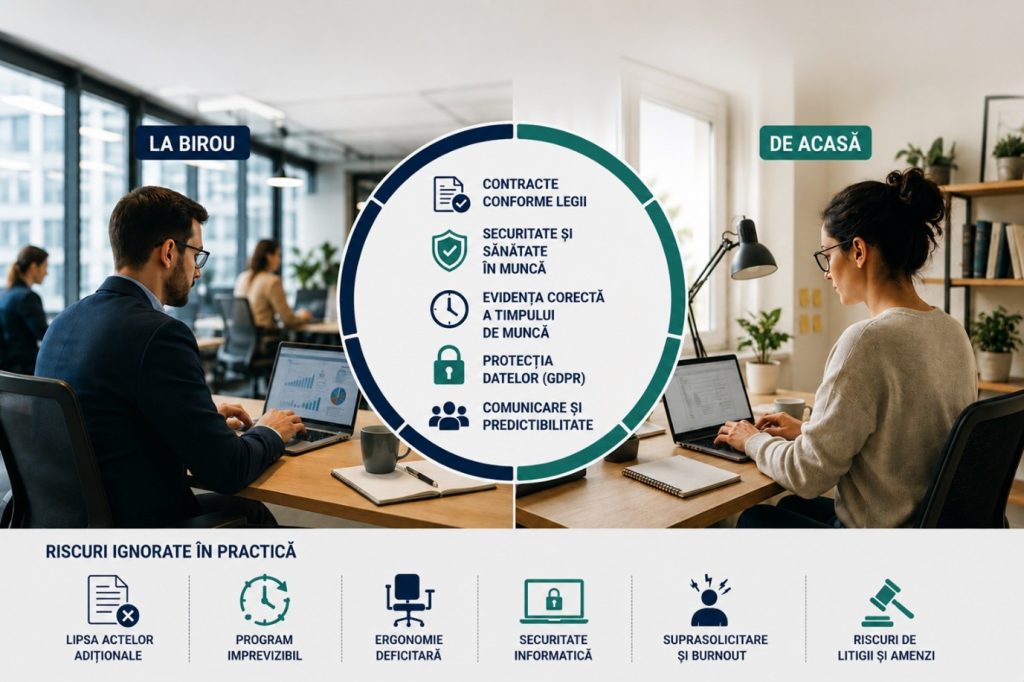
One of the most difficult problems raised by hybrid work is risk assessment and the allocation of responsibilities in the field of occupational health and safety.
The “Healthy Workplaces” 2023–2025 campaign run by the European Agency for Safety and Health at Work highlighted that remote and hybrid work give rise to specific risks:
– social isolation;
– digital stress and “technostress”;
– overwork;
– difficulties in delimiting working time;
– burnout;
– ergonomic disorders.
The central problem is that the employer has clear legal obligations, but its actual control over the workspace is limited.
For this very reason, risk assessment in telework requires mechanisms different from those used in the traditional setting of work at the employer’s premises. In practice, the following may be used:
– self-assessments carried out by the teleworker;
– checklists and internal guides;
– specific training;
– checks carried out with the employee’s consent;
– internal policies on the organisation of the workstation.
Ignoring these obligations may give rise to employer liability, including in the event of accidents at work or harm to teleworkers’ health.
the new risks of hybrid work
The accelerated digitalisation of employment relationships and the expansion of hybrid work have brought not only changes in the way work is organised, but also psychosocial risks that are increasingly difficult to manage. While telework was initially perceived almost exclusively as an advantage associated with flexibility and professional autonomy, the practice of recent years has shown that, in the absence of clear limits, this flexibility can lead to overwork and burnout.
One of the most significant problems caused by remote work is the blurring of the boundary between professional and personal life. When the home becomes at once a place of work, a place of rest and a personal space, actually delimiting working hours becomes much more difficult than where work is carried out exclusively at the employer’s premises.
Permanent connection through technology – e-mail, collaboration platforms, instant messaging applications or videoconferences – frequently creates the impression that the employee is continuously available. In many organisations, the flexibility promised by hybrid work gradually turns into a form of permanent professional presence, in which working time becomes hard to delimit in any real sense.
In practice, this phenomenon takes the form of:
– online meetings organised outside normal working hours;
– messages and requests constantly sent in the evening or at weekends;
– the expectation of immediate replies regardless of the time;
– difficulty in genuinely disconnecting from work;
– the uncontrolled extension of actual working time.
These situations are often tolerated or even perceived as “normal” in highly digitalised working environments, but their effects on mental health and work-life balance can be significant. The specialist literature and European studies increasingly use the term “technostress” to describe the stress associated with intensive and continuous use of technology at work.
The phenomenon is amplified by the high volume of information, the constant interruptions caused by notifications and the implicit pressure to be continuously available. Over time, these factors can lead to work-related anxiety, reduced concentration, strained personal relationships and, in the most serious cases, burnout syndrome.
From a legal perspective, these problems can no longer be regarded solely as internal organisational difficulties. They may give rise to disputes concerning:
– actual working time;
– overtime;
– compliance with rest periods;
– breach of the right to disconnect;
– the employer’s occupational health and safety obligations.
It must be emphasised that the employer’s occupational health and safety obligations are not limited to preventing physical risks. Current legislation and European practice attach growing importance to the psychosocial risks arising from the organisation of work, including those associated with remote work and hyperconnectivity.
In this context, employers are required to take genuine measures to prevent overwork, including by:
– setting clear rules on working hours;
– limiting requests outside working hours;
– regulating online availability;
– respecting rest periods;
– training managers on the risks associated with hyperconnectivity;
– promoting a genuine balance between professional and personal life.
Without such measures, the flexibility of hybrid work may in practice become a permanent source of stress and exhaustion, turning the advantages of digitalisation into an additional occupational risk factor.

Hybrid work and telework can no longer be regarded today as mere benefits granted to employees or as administrative measures intended solely to increase organisational flexibility. These ways of organising work have become stable components of modern employment relationships and produce concrete legal effects for both employers and employees.
The digitalisation of employment relationships has profoundly changed the way professional activity is organised, supervised and assessed, but it has not reduced the existing legal obligations under employment law. On the contrary, moving work outside the space directly controlled by the employer has made many obligations more complex and more difficult to manage in practice.
The employer remains responsible for compliance with occupational health and safety rules even where work is carried out from the employee’s home or from other locations chosen by the employee. At the same time, the obligations regarding data protection, information security, the recording of working time and compliance with rest periods continue to apply in full in the context of remote work.
One of the most common problems encountered in practice is the tendency to implement hybrid work informally, without appropriately adapting the contractual documentation and without drawing up clear internal rules. In many cases, telework operates purely at a practical level, without compliant addenda, without precisely defining the conditions under which the work is performed and without any real assessment of the risks arising from the new way of organising work.
This approach may have significant legal consequences:
– disputes over actual working time and overtime;
– conflicts over unilateral changes to working conditions;
– difficulties in establishing liability in the event of accidents at work;
– breaches of data protection and information security obligations;
– administrative fines imposed by the competent authorities.
Equally, the lack of coherent internal policies on telework and hybrid work frequently leads to inconsistent and unpredictable practices, in which flexibility gradually turns into permanent availability on the part of the employee and the line between professional time and personal life becomes ever harder to draw.
In this context, employers can no longer treat telework solely as a tool for reducing logistics costs or as a benefit occasionally granted to staff. Implementing hybrid work lawfully and effectively requires:
– clear contractual regulation of the conditions under which the work is performed;
– internal policies adapted to the new risks;
– a genuine assessment of occupational risks;
– clear rules on working hours and availability;
– compliance in the areas of cybersecurity and data protection.
The flexibility of hybrid work can be a real advantage for both employers and employees, but only to the extent that it is backed by contractual predictability, compliance with legal obligations and genuine mechanisms for protecting workers’ health and rights.
Without these elements, the advantages of digitalisation can quickly become sources of legal liability, labour disputes and significant organisational vulnerabilities.
In reality, the major challenge of hybrid work is not flexibility, but the employer’s ability to maintain the balance between autonomy, control, employee protection and legal compliance in an increasingly unpredictable working environment.
Author: P.A.
Copyright © 2026. All rights reserved.
