07/10/2026
Healthcare-associated infections (HAIs), traditionally known in legal and medical practice as “nosocomial infections”, are one of the most sensitive issues at the intersection of health law, civil liability and the institutional obligations of healthcare providers.
What makes these situations legally distinctive is that the occurrence of an infection in the course of medical care does not automatically lead to the conclusion that an individual case of malpractice exists. At the same time, however, Romanian law establishes a special liability regime for healthcare facilities in respect of harm caused to patients by healthcare-associated infections, a regime that goes beyond the classic scope of liability for a physician’s professional error.
The legal framework consists mainly of Law No 95/2006 on healthcare reform, Law No 3/2021 on the prevention, diagnosis and treatment of healthcare-associated infections, and the rules approved by Order of the Minister of Health No 1101/2016.
Law No 3/2021 expressly provides that the prevention of HAIs is a major national objective and imposes specific obligations on healthcare facilities regarding the prevention, diagnosis, treatment, recording and reporting of these infections.
Against this background, civil liability must be analysed separately on two levels: the liability of the healthcare facility for HAIs and the individual liability of medical staff for breach of their professional obligations.
The current legislation starts from the premise that the prevention and control of healthcare-associated infections is an institutional obligation, not merely an individual obligation of the physician or nursing staff.
Under Law No 3/2021, healthcare facilities must ensure the conditions necessary for the prevention and diagnosis of infections and for their appropriate treatment. Healthcare facilities are also responsible for preventing HAIs and must ensure the diagnosis, treatment, recording and reporting of cases.
This institutional responsibility is supplemented by the obligations laid down in Order No 1101/2016, which governs the organisation of HAI surveillance, prevention and control activities, their monitoring and reporting, and the mandatory standard precautions for preventing and limiting infections.
A particularly important element from a liability perspective is Article 8 of Order No 1101/2016, under which any harm caused to patients through failure to comply with the rules on HAI prevention or with professional standards on the quality of medical care may give rise to individual or institutional liability, in accordance with the law.
Accordingly, the rules on HAI prevention are not merely administrative or epidemiological in nature. Their breach may be directly relevant to the assessment of civil liability.
One of the most important legal distinctions is that between the existence of an HAI and the existence of a case of malpractice.
Under Law No 95/2006, malpractice is a professional error committed in the performance of a medical or medical-pharmaceutical act that causes harm to the patient and entails the civil liability of the medical staff and of the healthcare provider.
Malpractice therefore essentially requires identifying culpable professional conduct – error, negligence, imprudence, insufficient professional knowledge or acting beyond one’s competence – and establishing the link between that conduct and the harm caused.
In the case of an HAI, however, the legal issue is different.
It is not always necessary to identify a particular physician or nurse whose culpable conduct caused the patient’s infection. The healthcare facility’s liability may be engaged under the special regime established by Law No 95/2006, irrespective of whether individual fault on the part of medical staff is established.
This distinction has major practical consequences. The fact that the specific person who caused the transmission of the pathogen cannot be identified does not, in itself, mean that the healthcare facility is exonerated from liability.
The legal regime governing a healthcare facility’s liability for nosocomial infections is one of the most significant particularities of medical civil liability.
The case law of the High Court of Cassation and Justice (ÎCCJ) has held that, in matters of nosocomial infections, the healthcare facility’s liability is strict.
In one case examined by the ÎCCJ, the supreme court held that, where it has been proved that the patient contracted a nosocomial infection during hospitalisation and the healthcare facility has not proved the existence of the external exonerating cause provided for by law, civil liability may be engaged without the need to prove fault on the part of the healthcare facility.
This interpretation is essential because it changes the perspective on the dispute.
In an ordinary tort liability dispute, the claimant must, in principle, prove the unlawful act, the harm, the causal link and fault.
In HAI matters, however, the special regime significantly shifts the burden of proof as regards fault. Once the existence of the healthcare-associated infection and the resulting harm have been proved, the healthcare facility cannot defend itself solely by showing that its staff complied with professional rules. It must prove the existence of an external exonerating cause, under the conditions laid down by law.
Accordingly, the absence of individual fault on the part of the physician must not be confused with the absence of liability on the part of the healthcare facility.

In the legal analysis of HAIs, the healthcare facility’s safety obligation towards the patient plays a central role.
The healthcare facility is not only obliged to diagnose and treat the condition for which the patient was admitted. It must organise and carry out its medical activity in such a way as to reduce, within the limits set by medical and epidemiological rules, the risk of healthcare-associated infections.
This obligation is complex and involves, among other things, having and applying HAI prevention procedures, ensuring hygiene, disinfection and sterilisation, properly managing functional circuits, using equipment and materials appropriately, epidemiological surveillance, identifying and isolating relevant cases, reporting infections and responding appropriately in the event of an outbreak.
Order No 1101/2016 expressly provides that HAI surveillance, prevention and control form part of the staff’s professional obligations and must be included in each employee’s job description.
At the same time, Law No 3/2021 imposes institutional obligations on the healthcare facility regarding the prevention, diagnosis, treatment, recording and reporting of HAIs.
It follows that the safety obligation does not rest exclusively with the medical staff performing the medical act itself, but is distributed across several levels of the institution’s organisation.

The fact that a healthcare facility may be strictly liable for HAIs does not exclude the individual liability of medical staff.
On the contrary, where it is proved that the occurrence or aggravation of an infection was facilitated by a culpable breach of a professional obligation, the person at fault may be held civilly liable for the harm caused.
Factors relevant to the assessment of individual liability may include, for example, failure to observe standard precautions, failure to comply with the rules of asepsis and antisepsis, failure to follow the procedures for isolating an infected or colonised patient, failure to report a suspected HAI, failure to follow sterilisation procedures or breach of the applicable internal protocols.
Law No 3/2021 also lays down precise individual obligations. Medical staff are responsible for identifying signs suggestive of an HAI, and the occurrence of an infection in a hospitalised patient must be communicated to the competent unit of the facility. Physicians are also required to carry out the diagnostic steps necessary to confirm or rule out the healthcare-associated nature of the infection and to prepare the reporting documentation required by law.
Breach of these obligations may, depending on the specific circumstances, give rise to civil, disciplinary and, if the legal conditions are met, even criminal liability.
In HAI litigation, the most difficult evidentiary issue is not always the existence of an infection, but establishing its nature and the link between the infection and the harm.
It is essential to distinguish between:
The mere temporal coincidence between admission and the occurrence of an infection is not, in every case, sufficient to establish automatically that it is an HAI. This is precisely why the legislation requires procedures for identifying, diagnosing, reporting and monitoring these infections.
Law No 3/2021 requires physicians to carry out the diagnostic steps necessary to confirm or rule out the healthcare-associated nature of an infection, and the facility’s specialised unit has responsibilities in confirming or ruling out a suspected HAI.
In procedural terms, a forensic medical report or a specialist medical expert report may play a decisive role in establishing the causative agent, the probable time of infection, whether the infection is an HAI, the course of the infection and the relationship between the infection and the harm claimed.
The healthcare facility’s strict liability must not be confused with absolute liability.
The legal regime allows the facility to invoke and prove the existence of an external cause that could not be controlled and that led to the infection.
This point is particularly important because the existence of an HAI does not mean that every infection occurring in a hospital is, in itself, attributable to the healthcare facility.
In practice, the external cause must be assessed specifically, in light of the particular features of each case. A generic defence to the effect that infections are an inherent risk of medical activity is not sufficient. The facility must prove the specific circumstance that led to the infection and its external and uncontrollable nature within the meaning of the law.
Hence the importance of rigorously documenting HAI prevention and control activities.
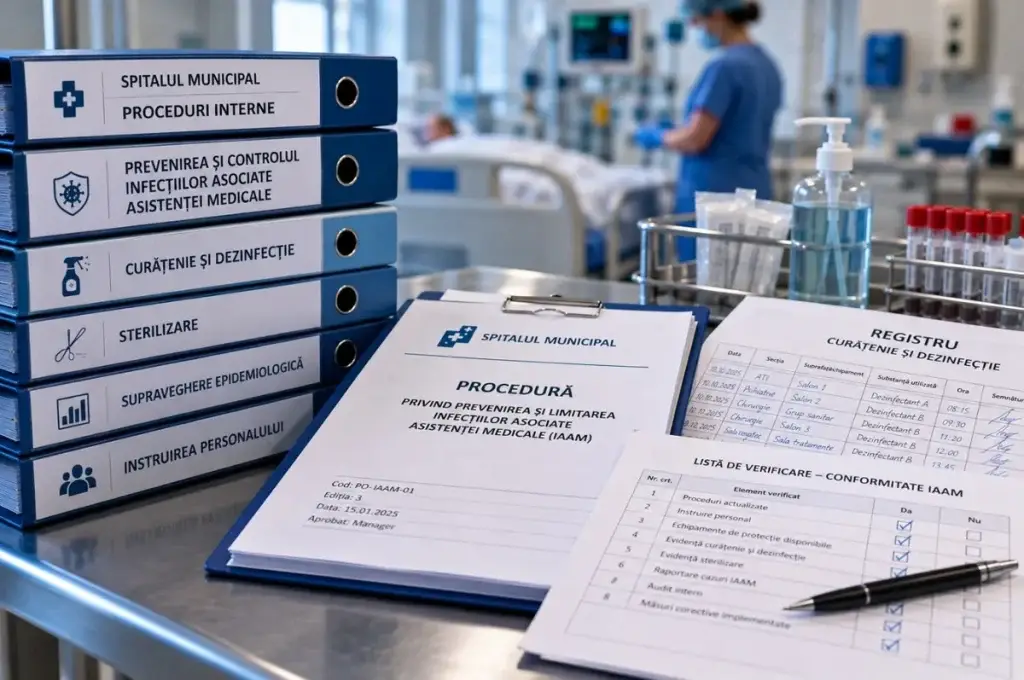
In any litigation, internal procedures, registers, self-monitoring reports, cleaning and disinfection records, sterilisation records, isolation protocols, staff training records, microbiology reports, epidemiological investigations and communications to the HAI prevention unit may acquire major evidentiary importance.
These documents are not merely of administrative value.
They enable the court to verify how the healthcare facility has fulfilled its prevention and control obligations and may help to delimit institutional liability from individual liability.
For this reason, procedures that have been formally adopted but are not applied in practice do not offer the facility any real legal protection. On the contrary, a discrepancy between the internal documentation and actual practice may become an unfavourable piece of evidence.
In the case of an HAI, a distinction must be drawn between two different legal questions.
The first is whether the healthcare facility is liable to the patient for the harm caused.
The second is whether, subsequently or at the same time, a person or category of persons can be identified who culpably breached their professional obligations and against whom individual liability may be engaged.
The two issues are not mutually exclusive.
The facility may be ordered to make good the harm even if no specific individual fault can be identified. Conversely, if it is found that a particular employee culpably breached their professional obligations and that this conduct contributed to the harm, the question of individual liability may arise and, where applicable, that of the facility’s recovery of the loss under the conditions laid down by law.
Accordingly, the identification of an individual failing must not be confused with the legal basis of the healthcare facility’s liability to the patient.
The harm caused by an HAI may have both a pecuniary and a non-pecuniary component.
Depending on the severity of the infection and its consequences, account may be taken of additional treatment costs, medical expenses, loss of income, reduced capacity to work, any future treatment or rehabilitation costs, and the non-pecuniary damage resulting from physical and mental suffering.
In severe cases, the infection may lead to prolonged hospitalisation, additional procedures, permanent sequelae or even the patient’s death.
In the event of death, the issue of civil liability may involve both the damage passing to the estate and the personal damage suffered by those entitled as a result of the loss of a close relative.
The damage must be assessed by reference to the specific and proven consequences of the HAI, not in the abstract by reference to the mere existence of the infection.
One of the most sensitive situations is where an HAI contributes to the patient’s death.
In such cases, the legal analysis must determine whether the infection was the direct cause of death, a concurrent cause or a factor that aggravated a pre-existing condition.
This distinction is essential because the existence of serious medical conditions prior to admission does not automatically exclude the healthcare facility’s liability.
At the same time, the fact that the patient died following an HAI is not sufficient, in itself, to conclude that all the consequences of the death are attributable to the healthcare facility.
Causation must be analysed both medically and legally, including by reference to the patient’s prior condition, the course of the disease, the causative agent, the time at which the infection occurred and the therapeutic interventions carried out.
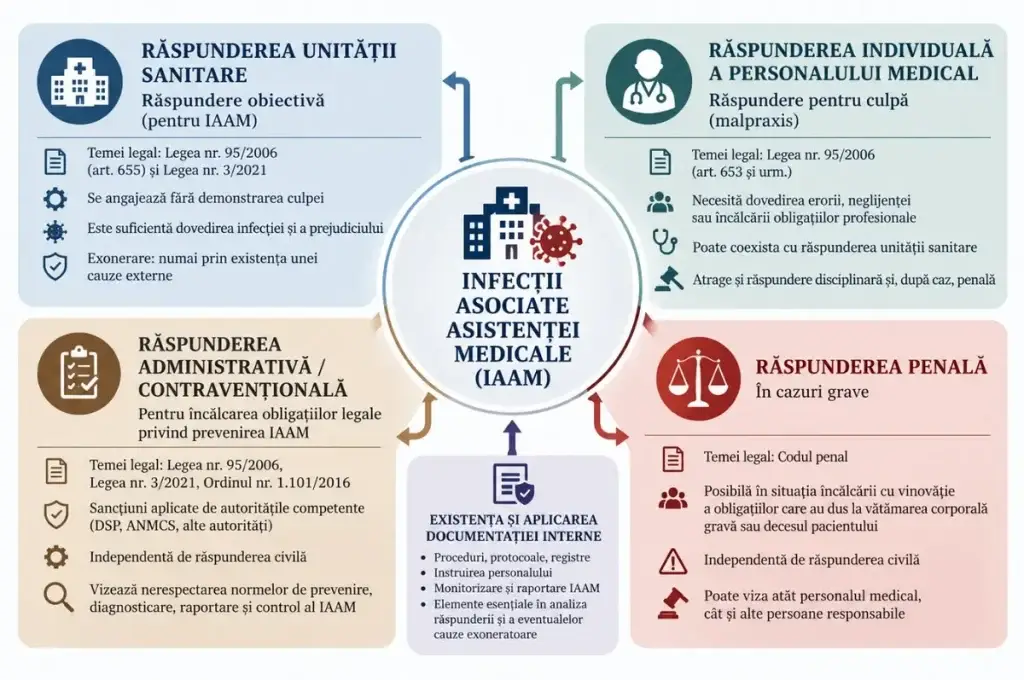
An HAI situation may give rise to several forms of legal liability at the same time.
Civil liability seeks to make good the harm.
Disciplinary liability seeks to sanction breaches of professional or employment duties.
Administrative-offence liability may arise where legal provisions sanctioned as administrative offences are breached.
Where the conduct of the persons involved meets the constituent elements of a criminal offence, criminal liability may also be considered.
These forms of liability have different legal bases and purposes and may exist independently of one another.
The legal regime governing healthcare-associated infections shows that civil liability in the healthcare sector cannot be reduced to the classic issue of individual medical error.
In HAI matters, the legislature has established a system in which the healthcare facility bears its own responsibility for patient safety and infection prevention. Law No 3/2021 strengthens this responsibility by imposing explicit obligations of prevention, diagnosis, treatment, surveillance, recording and reporting.
In parallel, Order No 1101/2016 lays down a detailed set of professional and institutional obligations and expressly provides for the possibility of individual or institutional liability for harm caused by failure to comply with HAI prevention rules.
The distinguishing feature, however, is the regime of the healthcare facility’s liability for nosocomial infections, which the case law of the High Court of Cassation and Justice has characterised as strict. In this area, a defence based solely on the absence of fault on the part of medical staff is not sufficient. Once the existence of the infection and of the harm has been established, the analysis shifts to whether there is an external cause exonerating the facility from liability.
Consequently, for healthcare facilities, HAI prevention is not merely a medical or epidemiological obligation, but also a legal one. Internal procedures, staff training, monitoring, documentation of prevention measures and accurate reporting of cases are essential not only for patient safety, but also for the institution’s legal position in the event of litigation.
Ultimately, liability for HAIs must be viewed in light of one fundamental principle: a healthcare facility cannot guarantee that no infection will ever occur, but it has a legal obligation to organise and carry out its medical activity in such a way that the risk of such infections arising and spreading is prevented and limited in accordance with the applicable legal and professional standards.
Author: P.A.
Copyright © 2026. All rights reserved.
