20/11/2026
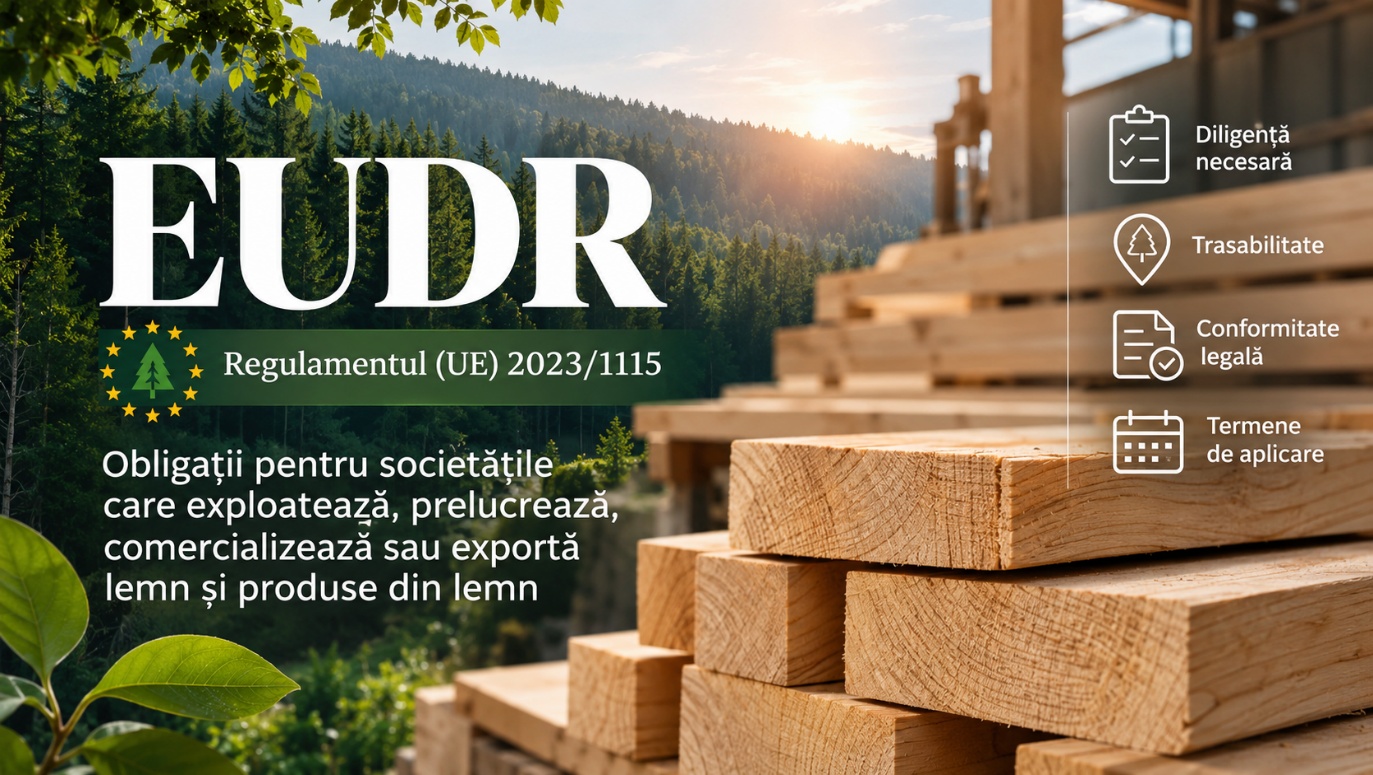
What businesses need to know about preventing deforestation, the traceability of raw materials and the compliance obligations applicable from 30 December 2026.
Regulation (EU) 2023/1115 of the European Parliament and of the Council, known as the EUDR (EU Deforestation Regulation), establishes a European legal framework aimed at preventing deforestation and forest degradation by imposing strict conditions on placing certain commodities and derived products on the EU market, making them available on the market and exporting them.
The Regulation seeks to ensure that products traded on the European market do not contribute to deforestation or forest degradation and that the raw materials used come from activities carried out in compliance with the legislation applicable in the country of production.
Its scope covers seven categories of commodities – cattle, cocoa, coffee, oil palm, rubber, soya and wood – as well as certain products derived from them, listed in Annex I to the Regulation.
In the wood industry, the Regulation may affect a wide range of businesses: forest owners and managers, logging companies, sawmills, furniture manufacturers, producers of wooden building components, traders, distributors, importers and exporters.
It is important to note that not every product made of wood automatically falls within the scope of the EUDR. Classification must be determined by reference to the customs codes and product descriptions set out in Annex I to the Regulation. Correctly identifying the CN codes of the products traded is therefore one of the first steps in establishing a company’s legal obligations.
Under Article 3 of the EUDR, relevant products may not be placed on the EU market, made available on the market or exported unless three fundamental conditions are all met.
The products must be “deforestation-free”. For wood, this means that the material must come from forests that have not been subject to deforestation after 31 December 2020 and that harvesting must not have caused forest degradation after that date, as defined in the Regulation.
The products must have been produced in accordance with the relevant legislation of the country of production. This covers the rules on land-use rights, environmental protection, forestry legislation, third-party rights, labour rights, human rights protected under international law, tax, trade and customs obligations, as well as the relevant anti-corruption rules.
The products must be covered by a due diligence statement or, where applicable, a simplified declaration. This is the operator’s formal confirmation that it has carried out the checks required by the Regulation and that the product complies with the applicable requirements.
These conditions are not mere paperwork requirements. They require the ability to demonstrate where products come from and that the legality and forest-protection criteria have been met.

One of the most important distinctions introduced by the Regulation concerns the company’s role in the supply chain. Obligations are not the same for all businesses, and the same company may have different roles depending on the products and trade flows concerned.
An operator is any natural or legal person who, in the course of a commercial activity, places a relevant product on the EU market for the first time or exports it, without being a downstream operator.
In practice, this category may include companies that harvest and sell wood, as well as companies that import sawn timber or other relevant products from outside the European Union and place them on the European market for the first time.
A downstream operator is any natural or legal person who places on the market or exports relevant products manufactured from other relevant products that have already been subject to due diligence upstream.
An example is a company that buys sawn timber lawfully placed on the EU market and covered by EUDR obligations, processes it and manufactures furniture, worktops or other wood products listed in Annex I. In such a case, the company may qualify as a downstream operator, provided the conditions laid down in the Regulation are met.
A trader is any person who, without being an operator or a downstream operator, makes relevant products available on the market in the course of a commercial activity.
This classification has direct consequences for compliance obligations. Operators have due diligence obligations, whereas downstream operators and traders mainly have obligations to collect and keep information about their business partners and products.
Companies that qualify as operators must carry out due diligence before placing relevant products on the EU market or before exporting them.
Under Articles 8 to 12 of the Regulation, the due diligence process has three main components:
Information gathering. The operator must obtain sufficient information, documents and data to identify the products and verify their compliance. For wood, the relevant information includes, among other things, the product description, the tree species with its common and scientific name, the quantity, the country of production, the date or period of harvest and the geolocation of the plots of land where the wood was harvested.
The operator must also hold information about its suppliers and verifiable documents demonstrating compliance with the legality requirements and the absence of deforestation.
Risk assessment. The information gathered must be analysed to determine whether there is a risk that the products do not comply with the EUDR. The assessment must take into account the criteria set out in the Regulation, including the complexity of the supply chain, the country of origin, the risk of mixing with products of unknown origin and any relevant information on non-compliance.
Risk mitigation. If the assessment identifies risks that cannot be considered negligible, the operator must take appropriate mitigation measures. Products may not be placed on the market or exported unless the risk of non-compliance has been reduced to a negligible level.
Once the procedure is complete, the operator submits the due diligence statement (DDS) in the EU information system. The reference number generated must be communicated to the first downstream buyer, as required by the Regulation.
The operator must also establish and maintain a due diligence system, review it regularly and keep the relevant documents for at least five years.

Article 5 of the Regulation lays down a separate regime for downstream operators and traders.
They are not required to carry out their own due diligence, to submit due diligence statements or simplified declarations, or to set up their own due diligence system for products that have already been checked upstream.
Nevertheless, there are record-keeping and traceability obligations that must be observed.
Downstream operators and traders must collect and keep information on the suppliers from which they purchased the relevant products, namely their name, trade name or registered trademark, postal address, e-mail address and, where available, website.
They must also collect and keep similar information on the downstream operators and traders to which they supplied the relevant products.
Where the supplier is an operator, the reference numbers of the due diligence statements or the identifiers of the simplified declarations for those products must also be kept.
This information must be kept for at least five years and made available to the competent authorities on request.
An important obligation applies where the company learns of new information or has substantiated concerns that products are non-compliant. In such cases, the competent authorities and the relevant downstream business partners must be informed without delay.
As regards company size, the Regulation provides for a differentiated regime: downstream operators and traders that are SMEs do not need to register in the EUDR information system. Companies that are not SMEs must register, but this does not require them to submit a new due diligence statement for products already subject to due diligence upstream.
Furthermore, non-SME downstream operators and traders must verify the due diligence carried out upstream only where they have substantiated concerns about non-compliance, not as a systematic check on every purchase.
The first downstream operator or trader that buys the product directly from the upstream operator has the additional obligation to collect and keep the DDS reference number or the identifier of the simplified declaration.
The Regulation allows a simplified due diligence procedure for operators that source exclusively from countries, or parts of countries, classified as low risk.
This is relevant for companies using raw materials from Romania, which the European Commission has classified as a low-risk country.
However, classifying a country as low risk is not a general exemption from the Regulation.
Operators must still collect the information required under Article 9, establish a due diligence system and assess the complexity of the supply chain, as well as the risk of circumvention of the Regulation or of mixing with products from standard-risk or high-risk countries or of unknown origin.
If the conditions of Article 13 are met, the operator may be exempted from the risk assessment and risk mitigation required under Articles 10 and 11, unless new information emerges indicating a relevant risk of non-compliance.
Separately, the Regulation provides a specific regime for micro and small primary operators that meet the legal conditions. Under Article 4a, they may submit a single simplified declaration instead of individual due diligence statements.
The EUDR has been amended several times, including by Regulations (EU) 2024/3234 and (EU) 2025/2650, which set new deadlines and simplified certain obligations.
As currently in force, the main obligations of operators, downstream operators and traders generally apply from 30 December 2026.
For operators that are natural persons, micro-enterprises or small enterprises and had that status on 31 December 2024, the deadline is, under certain conditions, postponed until 30 June 2027. However, this postponement does not apply to wood products that were already covered by Regulation (EU) No 995/2010 on timber (the EU Timber Regulation, EUTR).
Consequently, for sawn timber and other wood products covered by the former regulation, EUDR obligations apply from 30 December 2026, including for micro and small operators that otherwise benefit from the postponed deadline.
There are also transitional provisions for wood products harvested before 29 June 2023 and for products placed on the market during the transition period. Whether the transitional regime applies depends on the date of harvest, the date the product was first placed on the EU market and whether the product falls within the scope of the EUTR.
In such cases, the documents capable of proving the date of harvest and the date of first placing on the market must be examined separately. A date simply stated on the purchase invoice is not enough.
Regulation (EU) No 995/2010 (EUTR) will be repealed from 30 December 2026, with transitional rules maintained for certain categories of wood and wood products until 31 December 2029.

Failure to comply with the obligations under the EUDR can have significant consequences for businesses.
Article 25 requires Member States to lay down effective, proportionate and dissuasive penalties. These include fines proportionate to the environmental damage and the value of the relevant products, confiscation of the products or of the revenues from non-compliant transactions, temporary exclusion from public procurement procedures and, in the case of serious or repeated infringements, a temporary prohibition on placing relevant products on the market, making them available or exporting them.
For legal persons, the maximum fine must be at least 4% of total annual EU turnover in the financial year preceding the penalty decision, and may be increased where necessary to exceed the economic benefit gained from the infringement.
Beyond administrative penalties, non-compliance can have serious commercial consequences: blocked deliveries, inability to export, loss of contracts, additional verification costs and reputational damage.
With the application date approaching, companies in the wood industry should start reviewing their sourcing and sales flows early.
First, all products manufactured, purchased or sold must be identified and their CN codes checked against Annex I to the Regulation.
Second, companies must analyse their position in the supply chain and determine whether they act as operators, downstream operators or traders. This analysis must be carried out for each relevant flow, as the same company may have different legal roles depending on the operations it carries out.
Third, contracts with suppliers and customers should be reviewed to include clauses on the legal origin of the wood, compliance with EUDR requirements, the provision of traceability documents, the communication of DDS references where applicable and the notification of any suspected non-compliance.
It is also advisable to develop internal procedures for receiving raw materials, identifying and recording batches, archiving documents and handling cases where discrepancies arise regarding the origin of products.
Depending on the company’s status, it will need either to implement its own due diligence system or to set up a mechanism for collecting and keeping information on suppliers, customers and the relevant products.
The EUDR introduces obligations that go beyond the traditional checking of documents on the origin of timber. The new legal framework requires a structured approach to the entire supply chain, from harvesting the raw material to processing, selling and exporting finished products.
For companies in the wood industry, compliance does not necessarily entail the same level of obligations. Correctly identifying the legal role, classifying products and reviewing supplier documents are essential for determining which measures must be implemented.
In this context, early preparation, a review of contractual relationships and appropriate traceability mechanisms can reduce the legal and commercial risks associated with the application of the Regulation.
The Law Office of Dr. Florin Ludușan provides legal advice on assessing EUDR obligations, classifying businesses under the Regulation, reviewing commercial contracts, drafting internal documentation and assisting with the implementation of compliance measures.
Author: P.A.
Is this article useful to you?
Get it as a PDF on our letterhead, to keep or to share.
Get this article as a PDF
We will e-mail it to you on our letterhead, so you can keep it or pass it on to colleagues.
Copyright © 2026. All rights reserved.
We use cookies that are strictly necessary for the website to work and, only with your consent, statistics cookies (Google Analytics) that show us how the website is used. You can change your choice at any time under “Cookie settings”.
