01/10/2026
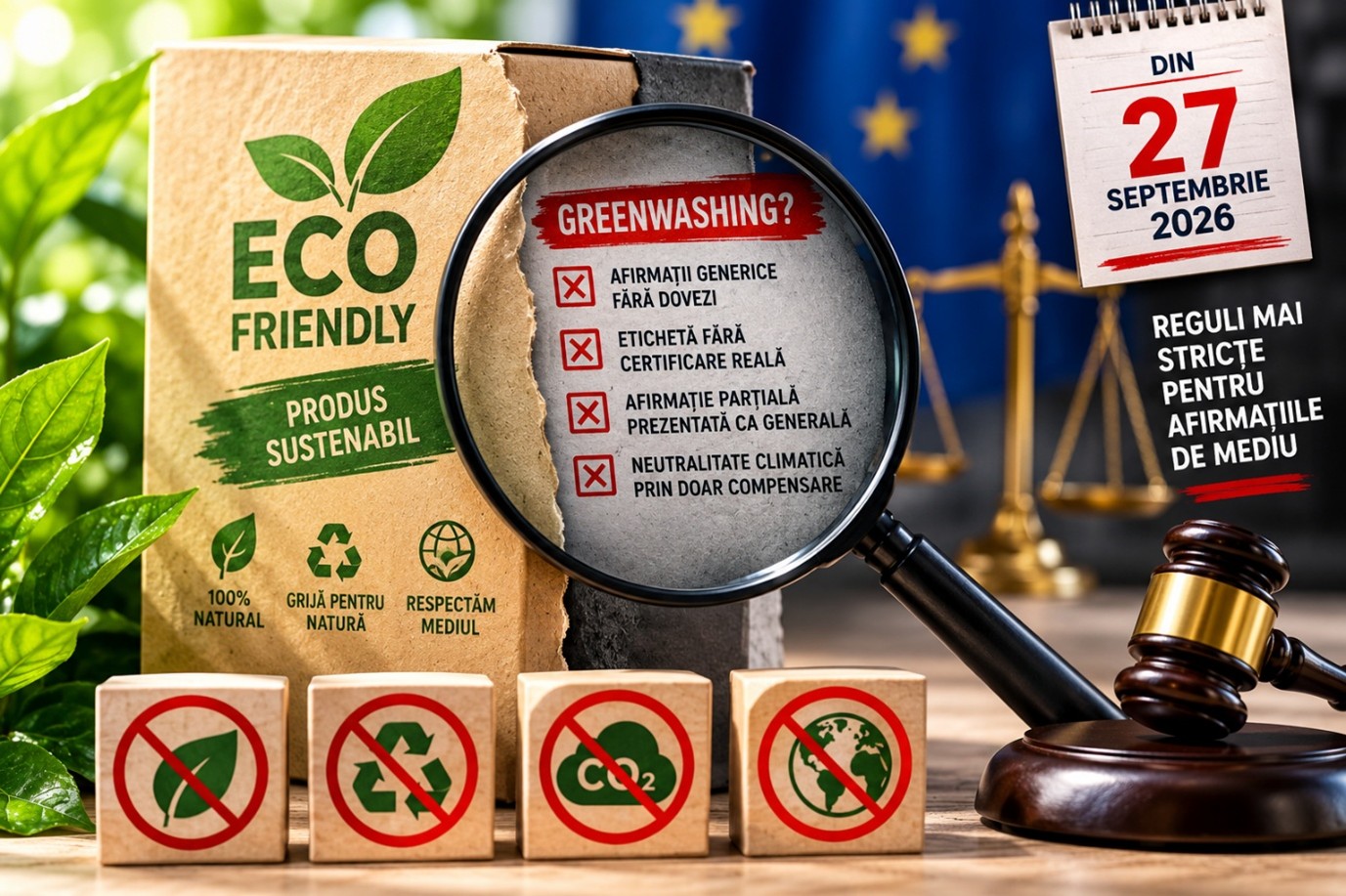
As of 27 September 2026, the legal framework governing unfair commercial practices has been significantly expanded by Government Emergency Ordinance (GEO) No 18/2026, which amends and supplements Law No 363/2007 on combating unfair commercial practices of traders in their relations with consumers.
The new provisions introduce much stricter rules for commercial communications concerning the environment, sustainability, durability and the environmental impact of products, including the use of eco-labels and “green” claims.
In essence, traders may no longer use, in their commercial communications, general claims, symbols or labels that give consumers the impression of superior environmental performance where that impression cannot be substantiated by objective, verifiable and relevant criteria. GEO No 18/2026 thus transposes into national law the requirements of Directive (EU) 2024/825 on empowering consumers for the green transition.
Law No 363/2007 now expressly defines an “environmental claim” as any message, representation, image, label, trade mark, name or symbol used in a commercial communication which states or implies that a product, product category, brand or trader has a positive impact or no impact on the environment, is less damaging to the environment than other products, or has improved its environmental impact over time.
The same category includes a “generic environmental claim”, namely an environmental claim made in writing, orally or through audiovisual means, where the specification of the claim is not provided in clear and prominent terms on the same medium.
Consequently, simple marketing expressions such as “eco”, “green”, “sustainable”, “environmentally friendly” or “caring for nature” can no longer be treated as mere advertising slogans without legal consequences.
One of the most significant changes introduced by the new rules is the prohibition on making generic environmental claims where the trader is unable to demonstrate recognised excellent environmental performance relevant to the claim. This conduct is now expressly included in the list of commercial practices that are considered misleading in all circumstances.
Accordingly, claims such as:
must be assessed in light of the specific meaning they convey to consumers and of whether there is an objective and verifiable basis for them.
In this context, the law recognises as a benchmark for “recognised excellent environmental performance”, among others, performance compliant with Regulation (EC) No 66/2010 on the EU Ecolabel or with certain officially recognised EN ISO 14024 type I ecolabelling schemes.
In practice, a company must be able to demonstrate what specifically makes the product more sustainable, by reference to concrete criteria, rather than simply relying on laudatory wording.
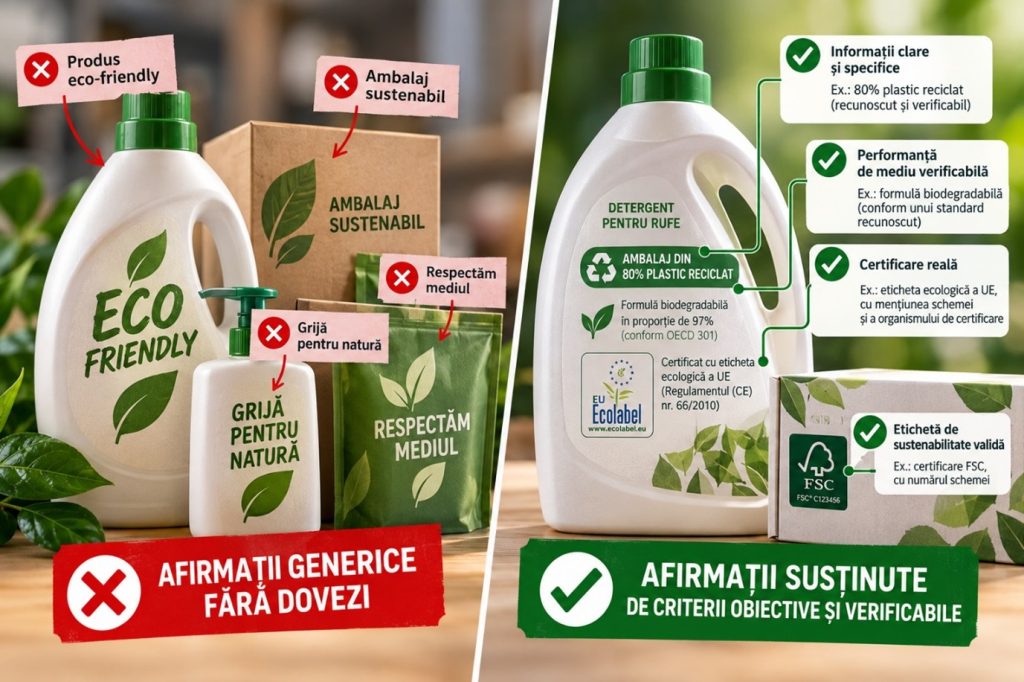
Another important issue concerns the use of proprietary symbols and labels.
The law defines a “sustainability label” as any voluntary trust mark, quality mark or equivalent, whether public or private, that aims to set apart and promote a product, a process or a business by reference to its environmental or social characteristics, or both.
At the same time, displaying a sustainability label that is not based on a certification scheme or not established by a public authority is now expressly included in the list of misleading commercial practices.
This means that a company cannot simply turn a drawing of a green leaf, a globe, a planet or any other graphic symbol into a purported environmental certification unless it is backed by a certification scheme that meets the legal requirements.
An “eco certificate” or similar wording must likewise be assessed in light of whether a genuine certification scheme exists. The law requires such a scheme to be transparent, open on fair terms, based on publicly available requirements and monitored through an objective procedure by a competent and independent third party.
The new rules also expressly address situations in which a limited characteristic of a product is presented as applying to the product as a whole.
The following is considered a misleading commercial practice:
making an environmental claim about the entire product or the trader’s entire business when it concerns only a certain aspect of the product or a specific activity of the trader’s business.
The examples are relevant to the day-to-day business of many traders:
The legal issue is not the existence of an environmentally beneficial characteristic, but rather its unjustified extension in commercial communications.
One of the most important changes concerns climate neutrality claims.
Annex No 1 to Law No 363/2007 classifies as a misleading commercial practice claiming, based on the offsetting of greenhouse gas emissions, that a product has a neutral, reduced or positive impact on the environment in terms of greenhouse gas emissions.
Accordingly, expressions such as:
cannot be based solely on the purchase of carbon credits or on emissions offsetting.
This distinction is important: emissions offsetting cannot be presented to consumers as equivalent to the actual elimination or reduction of the emissions generated by the product.
Commercial claims relating to delivery or transport – for example, “climate-neutral delivery” – must also be assessed carefully, since the general rule on environmental communications applies to any claim that creates an impression in the consumer’s mind regarding environmental impact. The precise legal characterisation depends on the content and specific context of the commercial message.
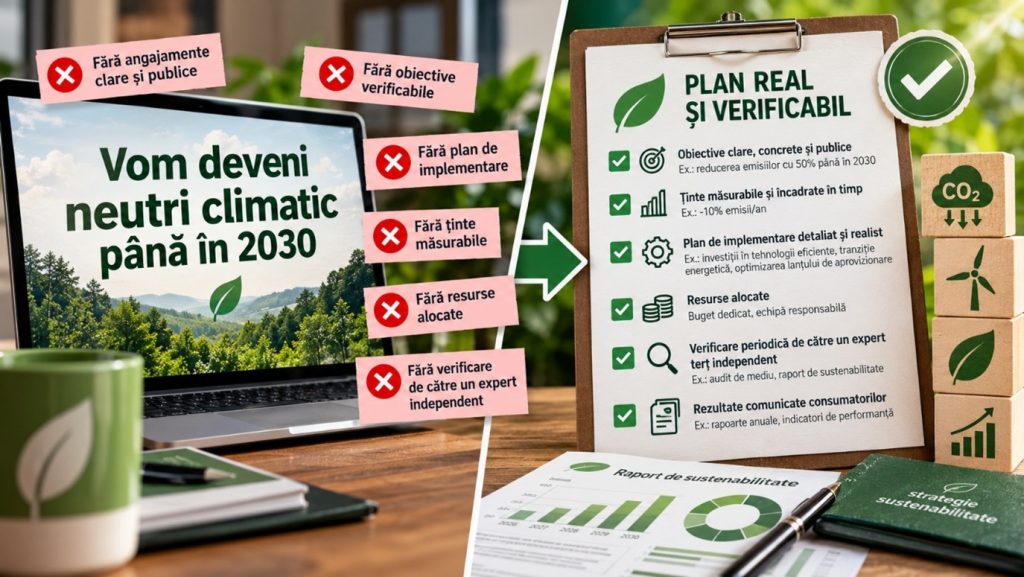
The new provisions do not concern only what a company says about its current environmental performance.
Making a claim about future environmental performance is considered a misleading action where the trader does not have:
Accordingly, claims such as “we will become climate neutral by 2030”, “our packaging will be 100% sustainable” or “we will eliminate plastic entirely” must be supported by a genuine, documented and verifiable commitment, not merely by a marketing strategy.
Under the current version of Law No 363/2007, misleading commercial practices, including those introduced by the new rules on environmental claims, are punishable by a fine of RON 20,000 to RON 100,000.
Where the unfair commercial practice affects more than 100 consumers, the minimum and maximum limits of the fine are doubled.
In certain cases involving widespread infringements or widespread infringements with a Union dimension, the legal framework allows a fine of between 0.1% and 4% of the annual turnover achieved in Romania in the financial year preceding the penalty, under the conditions laid down in Regulation (EU) 2017/2394.
Depending on the circumstances, additional remedial measures may also be imposed, and the enforcement officer may even propose the suspension of the provision of services, the supply of goods or the conduct of business until the unfair commercial practice ceases or the measures ordered are complied with.
The legal consequences of greenwashing may therefore extend well beyond the mere obligation to amend an advertisement or a package.
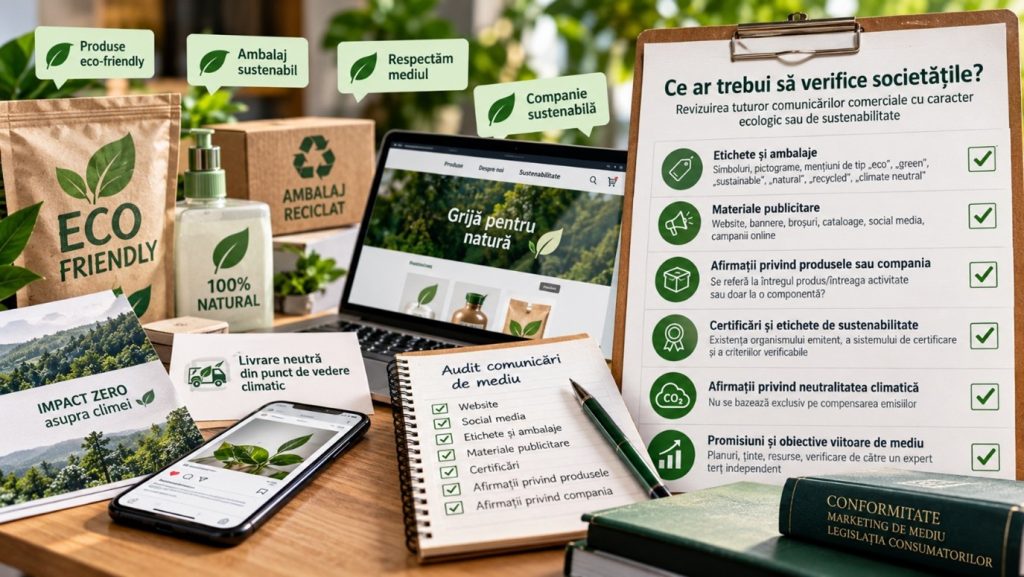
For traders, the entry into force of the new rules warrants a review of all commercial communications of an environmental or sustainability nature, not only of the labels affixed to products.
In practice, we recommend reviewing at least the following:
It should also be borne in mind that Law No 363/2007 treats environmental characteristics, durability, circularity, repairability and recyclability as relevant elements of a product’s main characteristics, so that their inaccurate or misleading presentation may constitute a misleading commercial action.
With the amendments applicable from 27 September 2026, Romanian law moves from a general approach to green advertising towards much more specific rules on what may be claimed, how a claim must be substantiated and what evidence must underpin the commercial communication.
For companies, the practical implication is clear: it is no longer enough for a claim to “sound green”. It must be accurate, relevant, proportionate, verifiable and supported by documentation.
In this context, our legal recommendation is that companies should not confine their review to the wording on packaging, but should carry out an audit of their environmental communications and marketing practices, separately verifying each claim, label and certification used commercially.
Author: SZ.I.
Copyright © 2026. All rights reserved.
