23/04/2026
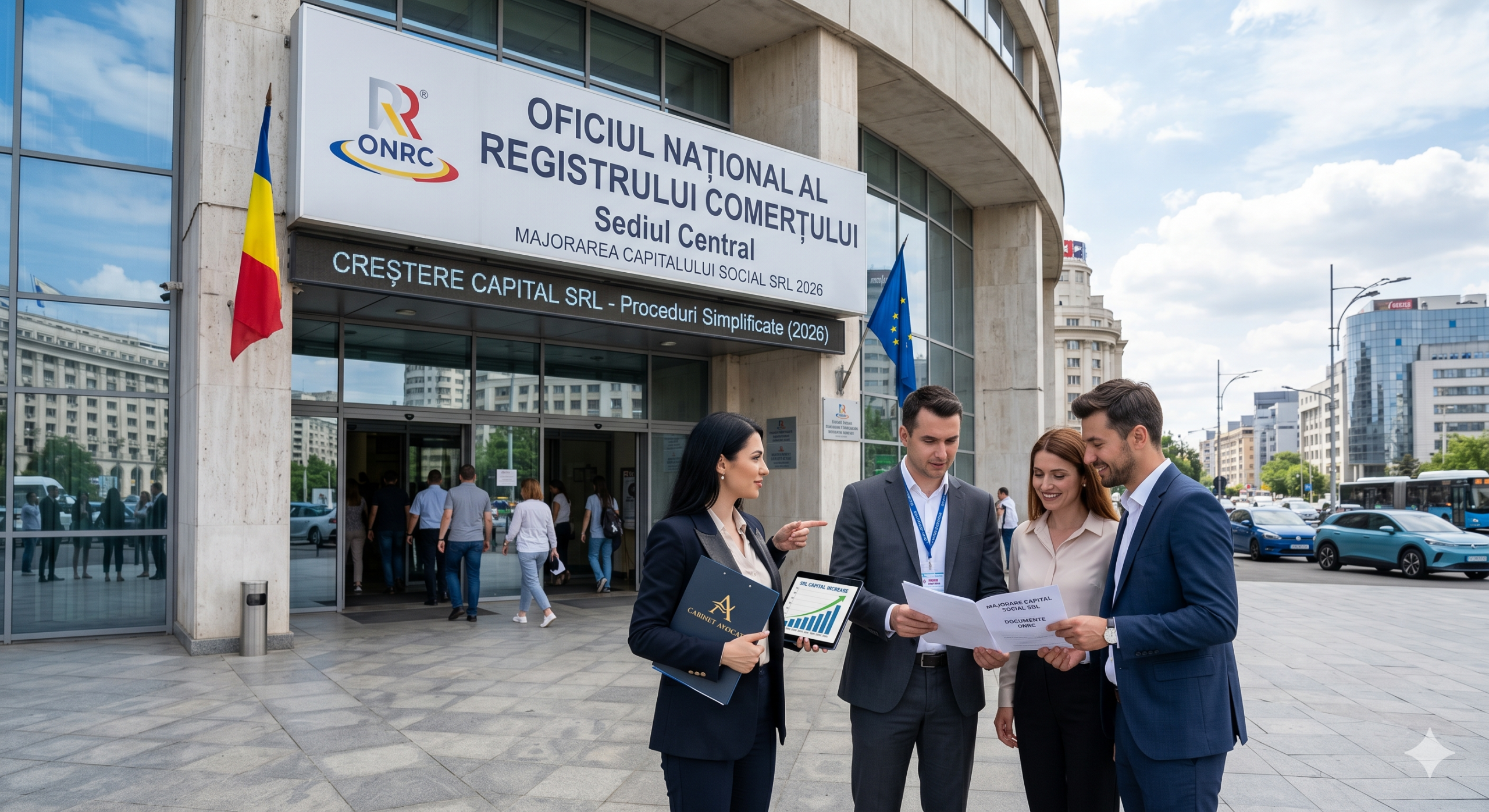
Quick summary: From 2026, thousands of Romanian SRLs are required to increase their share capital as a result of Law no. 239/2025. Failure to comply can lead to the dissolution of the company. In this article you will find the conditions, the methods and the exact steps of the legal procedure.
capital become urgent in 2026?
If you manage or represent a limited liability company, 2026 brings a concrete obligation you cannot ignore: increasing the share capital to the new minimum thresholds introduced by Law no. 239/2025, in force since 18 December 2025.
This legislative reform puts an end to the era of SRLs with token share capital — those with 200 lei, 1 leu or any other value below the legal threshold. The legislator's stated aim is to strengthen financial discipline, protect creditors and separate companies with genuine activity from "ghost" companies.
What are the new minimum thresholds?
The deadline for compliance is 18 December 2027 — that is, two years from the entry into force of the law. However, companies that carry out the increase by 31 December 2026 benefit from a 50% reduction in the Official Gazette publication fee, which makes acting now advantageous.
Please note: The share-capital value set in line with the threshold cannot subsequently be reduced even if turnover later falls below 400,000 lei. Once increased, the capital may no longer be brought below the legal minimum.
The legal consequence is serious: dissolution of the company. Under Article VIII of Law no. 239/2025, if a company has not topped up its share capital within the legal deadline, the court will order its dissolution at the request of any interested party or of ONRC.
The company can avoid dissolution only if, before the court's decision becomes final, the capital is brought up to the legal minimum. This is, in effect, a second chance — but with court proceedings already opened and with additional costs.
Beyond the risk of dissolution, non-compliance may also lead to:

what options does your company have?
The Company Law (Law no. 31/1990, Article 221 read together with Article 210) provides several ways in which an SRL may increase its share capital. Choosing the right method depends on the company's specific financial situation.
1. Cash contribution
This is the simplest and most common method. The existing shareholders pay money into the company's capital account, or new shareholders may be brought in who provide fresh capital. The contribution is evidenced by the bank statement or the confirmation of deposit.
Advantage: Fast procedure, minimal documentation.
Note: If a new shareholder is brought in, they must give a notarised declaration stating that they are not subject to any incompatibility with the status of shareholder.
2. Contribution in kind
Shareholders may contribute assets (equipment, vehicles, real estate, intellectual property rights). In this case, the Trade Register must appoint a valuation expert to certify the value of the asset contributed.
Advantage: Useful where the company holds valuable assets, without tying up cash.
Note: The procedure takes longer, owing to the valuation report.
3. Capitalisation of reserves or net profit
The company may convert into share capital its existing reserves (except statutory reserves), undistributed profit or share premiums. This is an "internal" accounting method — no new money is brought in; instead, existing resources of the company are converted.
Advantage: Requires no external cash contribution; ideal for companies with accumulated reserves.
Note: Requires presentation of the balance sheet or trial balance certified by a licensed accountant.
4. Set-off of certain, fixed and due claims
If the shareholders have lent money to the company (account 455), those claims can be converted into share capital by set-off. In effect, the company's debt to the shareholder becomes a capital contribution.
Advantage: Solves two problems at once: it reduces the company's debts and increases its share capital.
Note: The claim must be certain, of a fixed amount and due; supporting financial documentation is required.

how a share-capital increase is carried out
Step 1: Preliminary legal analysis
Before anything else, it is essential to assess:
The firm's recommendation: A preliminary analysis carried out by a lawyer specialising in commercial law can prevent costly errors and later blockages at the Trade Register.
Step 2: Convening and holding the General Meeting of Shareholders (GMS)
Increasing the share capital is an amendment to the Articles of Association and therefore falls within the exclusive competence of the Extraordinary General Meeting of Shareholders (under Article 113(f) of the Company Law).
If the company has a single shareholder, a Decision of the Sole Shareholder is issued, which has the same legal effect.
The GMS resolution / Decision of the Sole Shareholder must necessarily set out:
Step 3: Making the contribution and obtaining the supporting evidence
Step 4: Drafting the instrument amending the Articles of Association
The amending deed or updated Articles of Association reflecting the new share-capital structure is drawn up. The form of this document must meet the legal requirements — drafting by a lawyer ensures compliance with Law no. 31/1990 and avoids rejections at ONRC.
Step 5: Filing the application with the Trade Register (ONRC)
The complete file is filed at the counter or online via the ONRC portal (with a qualified electronic signature). Under Law no. 265/2022, the application may be submitted by post/courier or electronically.
Processing time: Usually three working days from the filing of the complete file — one day for filing, one for processing, one for the issue of documents.
Step 6: Publication in the Official Gazette
The resolution to increase the share capital must be published in the Official Gazette of Romania, Part IV. The publication cost is reduced by 50% for companies that carry out the increase solely to comply with the new legal thresholds, until 31 December 2026.
Step 7: Obtaining the updated documents
On completion of the procedure, the company receives:
These documents constitute legal proof of the new share-capital structure and must be provided to the bank, contractual partners and, where applicable, the tax authorities.

when it is not an obligation but a strategy
Beyond the legal obligation introduced in 2026, increasing share capital can be a strategic decision for any company. Here are the situations in which it is worth acting without being compelled by law:
Access to financing: Banks and credit institutions assess the level of share capital as an indicator of how serious a business is. A solid share capital increases the chances of obtaining a loan or a credit facility.
Participation in public tenders: Many public procurement procedures or contracts with public entities require a minimum share capital as an eligibility condition.
Attracting investors: When a new investor/shareholder is brought in, increasing the share capital is the legal mechanism by which their contribution is formalised and made enforceable against third parties.
Commercial credibility: Business partners, distributors and corporate clients often check the data in the Trade Register. A strong share capital sends a signal of stability.
Internal restructuring: Converting shareholder loans into share capital improves the company's balance sheet and can facilitate access to more favourable financial instruments.
From our practice, the most frequent errors leading to rejection of the file at ONRC or to later complications are:

I have an SRL with share capital of 200 lei. Am I obliged to raise it to 500 lei in 2026?
Not automatically. The 500-lei threshold applies to SRLs incorporated after 18 December 2025. For existing companies, the obligation to increase to 5,000 lei arises only if net turnover exceeds 400,000 lei.
Can I increase the share capital without bringing in new money?
Yes. If the company has reserves or undistributed profit recorded in its accounts, these can be capitalised into share capital without bringing in external funds. A trial balance/balance sheet certified by a chartered accountant is required.
If I have debts to ANAF, can I still increase the share capital?
Majorarea capitalului social în sine nu este condiționată de lipsa datoriilor fiscale. Totuși, dacă majorarea implică introducerea unui asociat nou (cesiune de părți sociale sau emitere de noi părți sociale), sunt aplicabile noile reguli din 2026 privind notificarea prealabilă a ANAF.
How long does the whole procedure take?
Increasing the share capital is not, in itself, conditional on the absence of tax debts. However, if the increase involves bringing in a new shareholder (a transfer of shares or the issue of new shares), the new 2026 rules on prior notification of ANAF apply.
If turnover later falls below 400,000 lei, can I reduce the share capital back down?
No. The law expressly provides that the minimum value set in line with the threshold cannot be changed even if turnover subsequently falls.
What happens if I miss the 18 December 2027 deadline?
Any interested party or ONRC may apply to the court for the dissolution of the company. The company can avoid dissolution if it brings the capital up to the minimum before the dissolution decision becomes final.
specialising in commercial law recommended?
The procedure for increasing share capital seems simple at first sight, but it involves the intersection of company law, tax law and Trade Register procedure. Errors in drafting the GMS resolution, omissions in the Articles of Association or overlooking the new 2026 tax obligations can turn a routine operation into a rejected file or, worse, a situation of non-compliance with financial consequences.
A lawyer specialising in commercial law will ensure:
This article is for information purposes only and does not constitute legal advice. For an analysis of your company's specific situation and assistance with the share-capital increase procedure, we invite you to contact our firm.
Author: F.R.I.
Copyright © 2026. All rights reserved.
