12/05/2026

Quick summary: As of 1 January 2026, under Law No 245/2025, any company that has a place of business with at least 1 employee at an address other than its registered office must obtain a separate tax identification number (CIF) for that secondary office. The former threshold of 5 employees has been removed. Government Ordinance No 6/2026, however, introduced important simplifications and extended the compliance deadline to 30 June 2026. Read on to find out who is affected, what steps must be taken and what penalties may apply.
If your company has a shop, a workshop, a warehouse, an office or any other secondary office located at an address different from its registered office, and at least one employee works there, 2026 brings a tax obligation you cannot ignore: separate tax registration of the place of business and obtaining its own tax identification number (CIF).
The reform was introduced by Law No 245/2025, published in the Official Gazette at the end of 2025 and in force since 1 January 2026. The act amends Article 32(7) of Law No 273/2006 on local public finances, removing the previous threshold of 5 employees that triggered the obligation of separate tax registration.
The stated aim of the legislature is to direct payroll income tax correctly to the local budget of the administrative-territorial unit (UAT) in which the employees actually work, a principle that until 2025 was undermined by the minimum threshold of 5 employees.
What exactly is the new rule?
1. An address different from the registered office + at least 1 employee at that location = the obligation to register the place of business for tax purposes as a payer of salaries and of income treated as salaries;
2. Obtaining a separate CIF for the separate recording of payroll tax and social contributions;
3. Filing Form 060 with the competent tax authority in whose territorial jurisdiction the place of business is located.
Please note: This tax obligation does not turn the place of business into an independent taxpayer for VAT or corporate income tax purposes. The company’s sole registration code (CUI) remains unchanged. The secondary CIF is used exclusively for declaring and paying payroll income tax for the employees working at that place of business.
the designated secondary office
A strict application of Law 245/2025 would have generated an explosive volume of tax registrations, which is why the Government stepped in quickly with Ordinance No 6/2026, published in the Official Gazette on 30 January 2026, which inserted Article 85¹ into the Fiscal Procedure Code (Law No 207/2015) and clarified two essential situations:
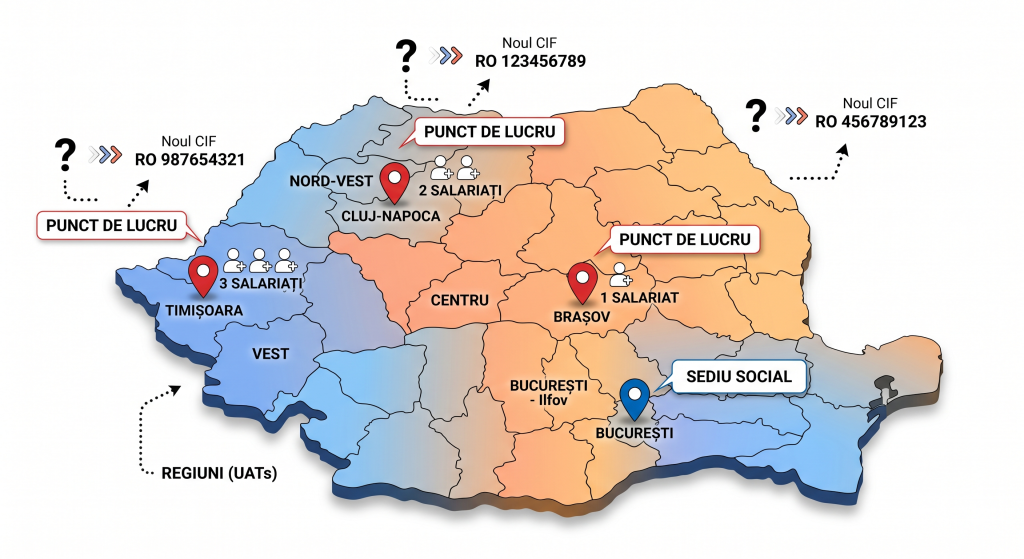
1. Secondary offices in the same UAT as the company’s tax domicile
If the secondary office is located within the same administrative-territorial unit (usually the same locality or the same Bucharest district) as the registered office, there is no obligation of separate tax registration and no separate CIF needs to be obtained. Payroll tax is paid using the company’s CUI.
2. Secondary offices in the same UAT, but one different from the tax domicile
If the company has several places of business within the same UAT (other than that of the registered office), one of them is designated as the “designated secondary office”, and tax registration is carried out for that office only. Payroll tax for all employees in that UAT is paid using the tax identification number of the designated office, regardless of the number of places of business.
Our firm’s recommendation: Before taking any steps with ANAF (the National Agency for Fiscal Administration), it is essential to draw up a “map” of all the company’s places of business, broken down by UAT, in order to identify correctly which are subject to separate tax registration, which require the designation of a secondary office and which require no additional formalities. Mistakes at this stage generate significant costs later on.
The tax registration obligation applies to:
1. Companies (SRL, SA, SCS, SCA) with secondary offices at an address other than the registered office;
2. Authorised natural persons (PFA), sole proprietorships and family businesses with secondary offices;
3. Non-governmental organisations (NGOs), foundations and associations with secondary offices;
4. Public institutions organised with secondary offices.
The cumulative condition is the existence of an address separate from the registered office + at least 1 employee actually working at that location (including part-time). Employees working purely by telework, without an actual secondary office being organised, do not fall into this category – but the assessment must be made on the specific facts (organisation of the premises, employment contracts, provisions of the individual employment contract regarding the place of work).

Under Law No 245/2025 read together with Government Ordinance No 6/2026, the compliance deadlines are as follows:
For places of business existing on 1 January 2026:
1. Deadline for notification/tax registration: 30 June 2026;
2. For entities with several secondary offices in the same UAT, notification of the designated secondary office and of the other secondary offices must be made by 30 June 2026;
3. The tax identification number assigned to the designated secondary office remains valid, while the other tax identification numbers are deregistered ex officio by the tax authority.
For places of business set up after 1 January 2026:
1. Deadline for filing Form 060: 30 days from the setting up of the place of business (the date of the shareholders’ resolution or of the premises contract, as applicable);
2. For designating the secondary office (when a second office is set up in the same UAT): 30 days from the setting up of the first secondary office.
Please note: The suspension of penalties provided for by Government Ordinance 6/2026 applies only to entities already established on the date Law 245/2025 entered into force and expires on 30 June 2026. After that date, failure to register places of business for tax purposes will trigger the administrative penalties provided for in the Fiscal Procedure Code.
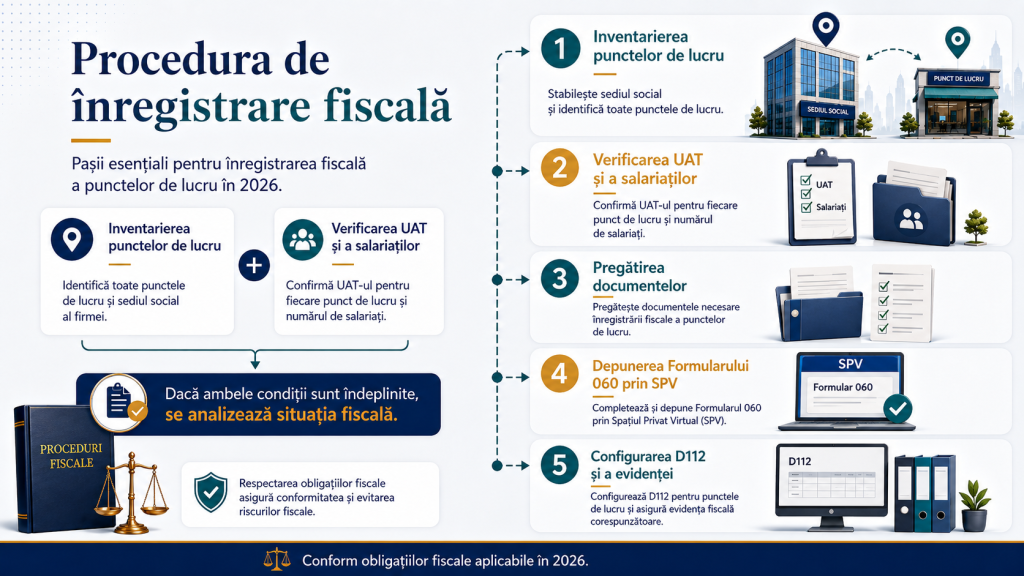
Step 1: Inventory of locations and assessment of the obligation
Before filing anything with ANAF, it is essential to check:
1. The up-to-date list of secondary offices (places of business) declared with the Trade Register;
2. The number of employees actually working at each location;
3. The UAT of each secondary office and how it relates to the company’s tax domicile;
4. Whether there is an obligation of separate registration, an obligation to designate a secondary office, or no additional obligation at all.
Step 2: Preparing the documentation
For each place of business that falls within the scope of the obligation, you will need:
1. Form 060 – Tax registration statement/Statement of amendments/Deregistration statement for secondary offices (updated by ANAF Order No 508/2026);
2. Proof of the existence of the place of business at that address (company status certificate issued by the National Trade Register Office – ONRC);
3. Proof of the right to use the premises (lease, loan-for-use agreement, title deed);
5. Details of the staff working at the place of business (REVISAL extract, individual employment contract/assignment decision);
6. The internal decision on organising the secondary office as a payer of salaries;
7. Power of attorney for the representative filing the statement, where applicable.
Step 3: Filing Form 060 via the Virtual Private Space (SPV)
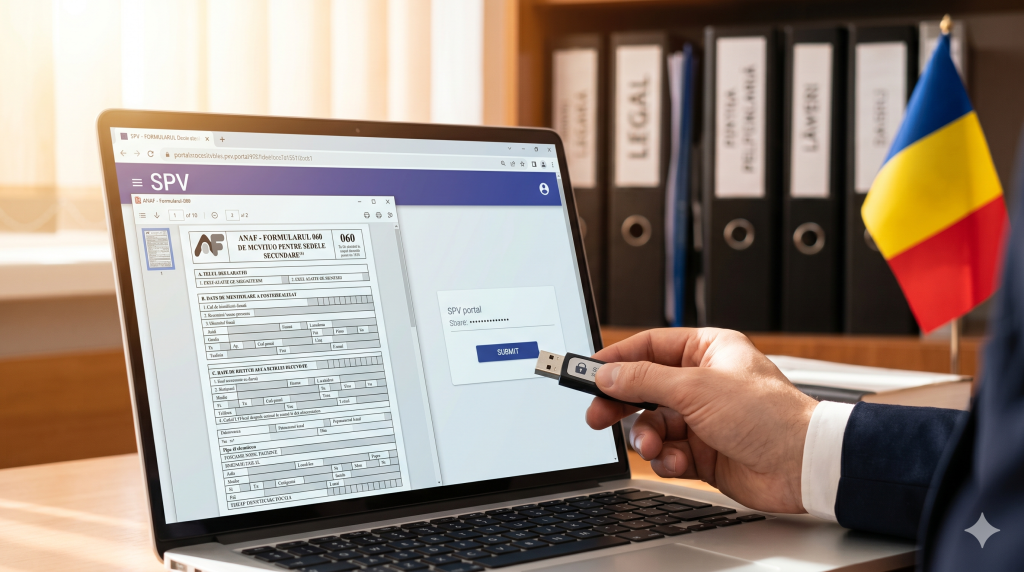
Filing is done exclusively electronically, via the SPV, with a qualified electronic signature. Under ANAF rules, communication with taxpayers that are legal entities has been carried out via the SPV since 1 March 2022.
Technical steps:
1. Accessing the SPV with a qualified digital certificate;
2. Completing Form 060 (ANAF smart PDF) with the details of the secondary office – address identical to the one in the supporting document, locality, county/district, postcode, date on which activity began;
3. Validating the form in the PDF;
4. Electronically signing the final file;
5. Uploading it to the SPV and submitting it to the competent tax authority;
6. Saving the receipt and archiving internally (receipt + signed PDF + proof of the CIF obtained).
Step 4: Obtaining the tax registration certificate
The tax authority issues the tax registration certificate for the secondary office, containing the secondary tax identification number. This number is used exclusively for reporting and paying payroll income tax and social contributions for the employees at that place of business.
Step 5: Setting up accounting records and tax reporting
Separate tax registration of the place of business has a direct impact on reporting:
1. The D112 return must be completed so that payroll income tax and social contributions are paid into the accounts corresponding to the place of business;
2. Employees’ summary records must be organised separately, by cost centre/entity, in the payroll and accounting software;
3. Document records (assignment decisions, employment contracts, attendance reports) must be kept separately for each office/place of business.
Step 6: Any subsequent changes – Form D700
To update the company’s tax vector (for example, removing payroll obligations from the main office’s vector when all employees are assigned to the secondary office), Form D700 is used, also filed via the SPV.
Failure to comply with the obligation to register the place of business for tax purposes constitutes an administrative offence under Article 336(1)(a) of Law No 207/2015 on the Fiscal Procedure Code.
The fines, laid down in Article 336(2)(d) of the same act, are as follows:
1. From RON 1,000 to RON 5,000 for legal entities classified as medium-sized and large taxpayers;
2. From RON 500 to RON 1,000 for other legal entities and for natural persons.
Please note: For entities already established on 1 January 2026, penalties are suspended until 30 June 2026 by Government Ordinance No 6/2026. From 1 July 2026, ANAF may apply the statutory fines in full.
In addition to the administrative fine, failure to register correctly for tax purposes can have serious collateral consequences:
1. D112 returns deemed incorrect, which means redoing the reports and recalculating tax liabilities;
2. Payroll tax allocated to the wrong local budget, with an obligation to regularise it later;
3. Non-declaration penalties of 0.08% per day for tax liabilities not declared or declared incorrectly, under Article 181 of the Fiscal Procedure Code;
4. Problems during tax inspections and ANAF compliance checks;
5. Inability to close employment relationships correctly and to issue certificates for the employees concerned.
In our practice, the most common mistakes that leave companies non-compliant or lead to their documentation being rejected are:
1. Confusing registration with the ONRC and tax registration with ANAF – these are two separate procedures with different deadlines (15 days at the ONRC for registering the place of business, and 30 days at ANAF for tax registration);
2. Not knowing the UAT rule – many companies file tax registration applications for offices located in the same UAT as their tax domicile, even though the law does not require this;
3. Failing to designate the secondary office where there are several places of business in the same UAT (other than that of the registered office);
4. Inconsistent addresses between the premises contract, the ONRC entries and Form 060 – any discrepancy leads to the application being rejected;
5. Payroll software not configured correctly – even if the CIF has been obtained, if the D112 is not generated with a breakdown by place of business, the reporting remains incorrect;
6. Treating telework as a place of business or, conversely, ignoring a real, functioning office where employees work.
My company has its registered office in Bucharest, District 1, and a place of business in District 3 with a single employee. Do I need a separate CIF?
Yes. District 3 is a different UAT from District 1, and the presence of even a single employee triggers the obligation of separate tax registration of the secondary office using Form 060.
What if my registered office is in Bucharest, District 2, and I have several places of business, also in District 2, with employees?
In this case Article 85¹(3) of the Fiscal Procedure Code, introduced by Government Ordinance 6/2026, applies: there is no obligation of separate tax registration, because all the secondary offices are in the same UAT as the company’s tax domicile. Payroll tax is declared and paid using the company’s CUI.
I have two places of business in Cluj-Napoca and my registered office is in Bucharest. Do I need two CIFs?
No. Since both places of business are in the same UAT (Cluj-Napoca), and that UAT is different from that of the registered office, the company must designate one of the two places of business as the designated secondary office and obtain a single CIF for it. Payroll tax for both places of business is paid using this CIF.
My place of business has no employees. Do I have any obligation?
No, as far as tax registration as a payer of salaries is concerned. The obligation applies only to places of business with at least 1 employee. However, the place of business must be declared to the ONRC and entered in the Trade Register if the company actually carries on activity at that address.
What happens if I open a new place of business with employees after 1 July 2026?
The deadline for tax registration is 30 days from the setting up of the place of business. Failure to file Form 060 on time triggers the fines provided for in Article 336(2)(d) of the Fiscal Procedure Code.
Does the payment of payroll tax change in any way?
Yes. Starting with the month in which the CIF for the place of business is obtained, payroll income tax for the employees concerned is paid to the local budget of the UAT in which the activity is carried out, and the D112 return must reflect this breakdown.
What happens if the place of business is temporarily inactive?
If the organised entity and its employees still exist (even if activity is temporarily suspended), the tax registration obligation continues to apply. If activity has ceased permanently, a deregistration statement must be filed for the secondary office (also using Form 060).
and a chartered accountant is recommended
Implementing Law No 245/2025 and Government Ordinance No 6/2026 is not a mere administrative formality. The procedure lies at the intersection of company law, tax law, administrative procedure and employment law, and mistakes have direct consequences for the monthly reporting flow, the accounting records and the relationship with ANAF.
A lawyer specialising in commercial and tax law, working together with a chartered accountant, can ensure:
1. A complete mapping of the corporate structure and precise identification of the places of business that require a separate CIF or a designated secondary office, or that fall outside the scope of the obligation;
2. Drafting of internal decisions on the designation of the secondary office and the organisation of tax reporting;
3. Verification of the Trade Register documents and of the consistency of the data with the tax records;
4. Filing of Form 060 and its supporting documents via the SPV, within the statutory deadlines;
5. Representation before ANAF in any verifications, inspections or appeals;
6. Optimisation of the internal payroll and D112 reporting process by cost centre/entity;
7. Ongoing advice on subsequent legislative updates, given that this area is changing rapidly.
Given that the grace period expires on 30 June 2026 and that, from 1 July 2026, administrative fines will be applied in full, acting preventively, ahead of the deadline, is the only rational strategy for any responsible director.
This article is for information purposes only and does not constitute individualised legal or tax advice. For an analysis of your company’s specific situation, identification of the specific obligations to register places of business for tax purposes and assistance with the full procedure before ANAF, please contact our firm.
Author: F.R.I.
Copyright © 2026. All rights reserved.
We use cookies that are strictly necessary for the website to work and, only with your consent, statistics cookies (Google Analytics) that show us how the website is used. You can change your choice at any time under “Cookie settings”.
