18/08/2026

Quick summary: When the net assets of an SRL (Romanian limited liability company) fall below half of the subscribed share capital, the law does not leave the director free to choose whether to act — it requires him to. Failure to convene the general meeting and to take measures to restore the share capital exposes the company to judicial dissolution and the director to personal liability. This article explains the specific obligations, the time limits, the procedure before the Trade Register and the mistakes that prove costly.
half of the share capital” means in law
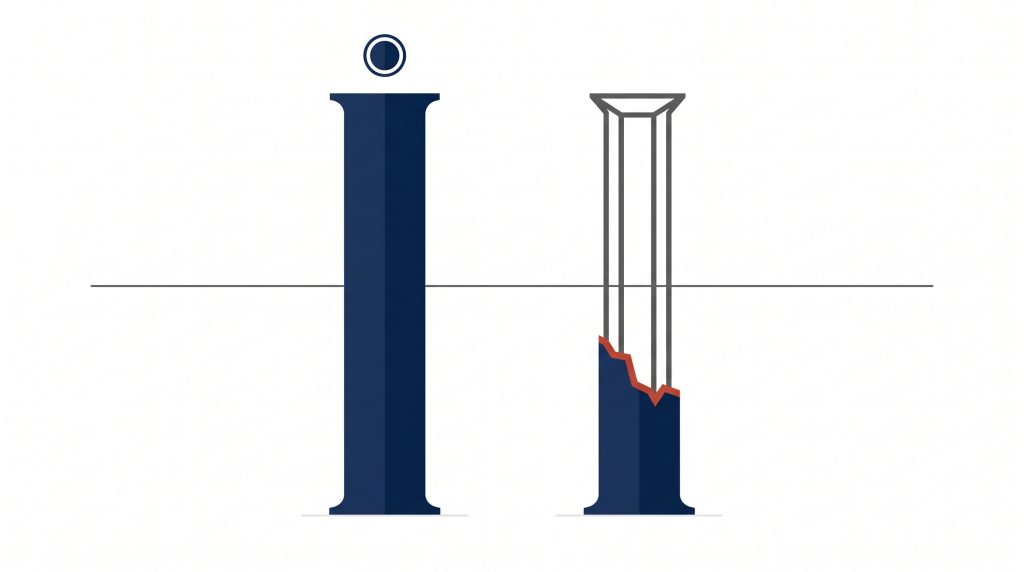
Net assets are the difference between the company's total assets and its total liabilities — in practice, the equity shown in the balance sheet. When accumulated accounting losses erode that value to below 50% of the subscribed share capital, the company enters a zone in which the legislature considers that the guarantee offered to creditors has become illusory.
This is not merely an accounting issue. It is a legal fact giving rise to obligations, triggered at the moment the annual financial statements are approved. From that moment, the director has a fixed period within which to act, and his inaction itself becomes a culpable act.
A practical example: an SRL with a share capital of RON 5,000 and losses carried forward that bring equity down to RON 1,800 is below the threshold. An SRL with a share capital of RON 200 and negative equity of RON -40,000 is, obviously, in the same situation — only far more serious, because its net assets are negative.
The basic mechanism, for joint-stock companies, is the one laid down in Article 153²⁴ of Law No 31/1990 on companies, which requires the board of directors to convene the extraordinary general meeting where the net assets have fallen to less than half of the value of the subscribed share capital.
Its practical relevance has risen sharply in 2026 for two reasons that compound each other. First: under Law No 239/2025, in force since 18 December 2025, SRLs with a net turnover exceeding RON 400,000 are required to increase their share capital to a minimum of RON 5,000 (we discussed the procedure at length in an earlier article). Second: with a higher share capital, the 50% threshold is measured against a higher value — which means that companies that have had no problem so far will fall below the threshold immediately after the increase if they have substantial losses carried forward. This is a side effect that few directors anticipated.
Please note: a share capital increase carried out mechanically, solely for the sake of compliance, without an analysis of the company's equity, may create a new legal problem in place of the one resolved.
1. The obligation to establish the situation. The director cannot defend himself by claiming that he did not know. The annual financial statements are prepared under his responsibility, and the reduction in net assets follows directly from the balance sheet.
2. The obligation to convene the general meeting. The meeting must be convened within the statutory time limit from the date on which the reduction was established — at the latest upon approval of the financial statements.
3. The obligation to submit a reasoned proposal to the meeting. The notice of meeting and the materials made available to the shareholders must state the causes of the losses and the measures proposed. A purely formal notice, devoid of substance, does not protect the director.
4. The obligation to implement the resolution of the general meeting and to register the corresponding entries with the Trade Register.

Restoring the share capital through a new contribution. The shareholders pay funds into the company's account, covering the losses and bringing the net assets back above the threshold. This is the clean solution, but it requires liquidity.
Converting shareholder loans into share capital. If the shareholders have lent money to the company, claims that are certain, liquid and due may be converted into capital. Two problems are solved at once: liabilities decrease and net assets increase. In practice, this is the most widely used solution for companies with no available cash.
Reducing the share capital to a level aligned with the remaining net assets. This is the “accounting” solution, but it carries a real legal cost: the resolution is published in the Official Gazette, and the company's creditors have the right to lodge an objection within the statutory time limit, the reduction taking effect only once that period has expired.
Voluntary dissolution of the company, followed by liquidation. This is the honest option where the business no longer has any prospects, and it is clearly preferable to a judicial dissolution ordered at the request of a creditor.
The firm's recommendation: the choice between these options is not an accounting decision but a legal and tax one. Converting a claim at the wrong time, or reducing the capital without first reviewing the creditors, may give rise to litigation that the company cannot afford.
The main consequence is the judicial dissolution of the company. The court having jurisdiction is the tribunal of the place where the company has its registered office, and the application may be brought by any interested person — typically a dissatisfied creditor, a former shareholder or a contractual partner in dispute with the company.
The court may grant the company a grace period in which to regularise its position — but by then the case is already pending, legal costs are accruing and the entry recording the action becomes public.
The consequences that do real damage, however, are the related ones:

Step 1: Preliminary legal and accounting analysis. This establishes the exact value of the net assets at the balance sheet date, the causes of the losses, the existence of any tax debts and the structure of the shareholders' claims against the company.
Step 2: Convening the extraordinary general meeting, in compliance with the form and time limit laid down in the articles of association. In a single-shareholder company, a Decision of the Sole Shareholder is issued.
Step 3: Adopting the resolution. The resolution must contain an express finding of the reduction in net assets, the measure adopted, the exact amounts and the time limits for implementation. A vague resolution is the main reason for rejection of the file.
Step 4: Implementing the measure — bank payment, documentation for the set-off of the claim or, as the case may be, the formalities for the capital reduction.
Step 5: Drafting the updated articles of association, reflecting the new structure of the share capital.
Step 7: Publication in the Official Gazette, Part IV, and — in the case of a capital reduction — waiting for the creditors' objection period to expire before the operation takes effect.
If the capital restoration also involves the entry of a new shareholder or a transfer of shares, the ANAF (Romanian tax authority) screening introduced in 2026 applies in addition (discussed in detail in a dedicated article).

How do I know whether my company is below the threshold?
Compare the equity shown in the balance sheet (net assets) with the subscribed share capital. If the former is less than half of the latter, the obligations described in this article are triggered.
I have had losses carried forward for several years, but the company operates normally. Is this a real problem?
Yes. The statutory obligation does not depend on whether the company pays its suppliers on time. It is triggered by the accounting criterion, not the liquidity criterion.
Can I cover the losses without bringing new money into the company?
Often, yes — by converting loans that the shareholders have already granted to the company or by capitalising available reserves. Supporting accounting documentation is required.
What happens if I have just increased the capital to RON 5,000 under Law No 239/2025 and I am now below the threshold?
You are in exactly the situation this article describes. The two obligations must be dealt with together, through a single well-structured operation, not one after the other.
Can a creditor apply directly for the dissolution of my company?
Any person who demonstrates an interest may apply to the tribunal. The company can avoid dissolution by regularising its position, but only up to a certain stage of the proceedings — which is why a swift response matters enormously.
Am I liable with my personal assets?
Not for the company's debts, as a rule. However, the director may be held personally liable for the loss caused by failure to fulfil the statutory obligations to convene the meeting and to act with due diligence, and in insolvency the exposure is significantly greater.
specialising in commercial law recommended?
A situation of reduced net assets lies at the intersection of company law, accounting, tax law and Trade Register procedure — and the time limits run regardless of whether the director is aware of them. A specialised lawyer determines the optimal measure for the company's specific situation, drafts the general meeting resolution and the updated articles of association so that the file is accepted by the ONRC (National Trade Register Office) at the first attempt, assesses the exposure to creditors' objections and, where appropriate, builds the documentation that protects the director in the event of insolvency proceedings.
Our firm assists legal entities exclusively, with clients throughout the country, in share capital restoration and restructuring procedures, corporate changes and representation in commercial litigation.
This article is for information purposes only and does not constitute legal advice. For an analysis of your company's specific situation, please contact our firm.
Author: F.R.I.
Copyright © 2026. All rights reserved.
