21/05/2026

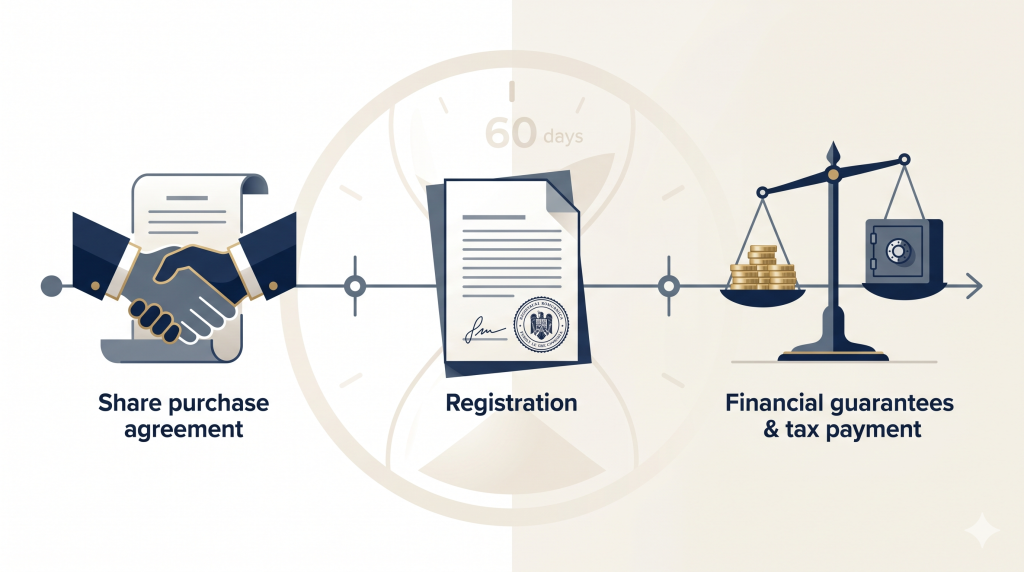
Quick summary: From 9 March 2026, selling an SRL or a shareholder's withdrawal can no longer be finalised without tax validation from the National Tax Administration Agency (ANAF). GEO no. 13/2026 introduces an integrated ONRC–ANAF mechanism whereby every transfer of shares is checked for tax purposes before registration. For companies with debts to the State, the transfer is approved only against security, and if the obligations are not settled within 60 days, the security is enforced. This article explains, step by step, the new procedure and the pitfalls to avoid.
under strict tax control in 2026?
If you manage an SRL and plan to sell the company, to withdraw from the shareholding or to bring in a new shareholder by transferring shares, 2026 marks a structural change in the rules. The transfer of shares is no longer a private legal act between transferor and transferee, completed by a simple filing with the National Trade Register Office (ONRC). It has become an operation subject to a double control - legal at ONRC and fiscal at ANAF - through integrated verification mechanisms.
Through this reform, the Romanian State pursued two clear objectives:
1. Putting a stop to the phenomenon of "selling companies with tax debts" - a practice whereby entrepreneurs who left behind unpaid obligations to the State budget escaped liability by formally transferring the SRL to nominees or fictitious persons.
2. Protecting creditors and contractual partners - who, until 2026, often discovered after takeover that the company had hidden debts or that the former director had disappeared without trace.
The legal basis of the new procedure consists of two successive pieces of legislation:
1. Law no. 239/2025 on certain measures for the recovery and more efficient use of public resources (the second fiscal package), published in Official Gazette no. 1160/December 2025, in force from 18 December 2025. Article V of this law introduced, for the first time, the obligation to notify ANAF in the case of a transfer of shares.
2. Emergency Ordinance no. 13/2026, published in Official Gazette no. 181 of 9 March 2026, which, through Article I, amends Article V of Law no. 239/2025 and formalises ONRC's role in automatically requesting the Tax Clearance Certificate from ANAF.
the former and the current regime
The former regime (until 18 December 2025)
Under the regime of the Company Law (Law no. 31/1990), transferring shares to a third party essentially followed these steps:
– The resolution of the General Meeting of Shareholders (GMS) or the decision of the sole shareholder approving the transfer;
– Conclusion of the transfer agreement between transferor and transferee;
– Updating the Articles of Association;
– Filing the application with ONRC;
– Registering the filing and making it enforceable against third parties.
ANAF did not intervene in this process. A company with tax debts could be sold without the tax authority being notified and without the operation being blocked.
The current regime (from 9 March 2026)
Under the regime of Law no. 239/2025, as amended by GEO no. 13/2026, the transfer of shares is not enforceable against the central tax authority unless the following conditions are met cumulatively: următoarele condiții:
– Notification of ANAF within 15 days of the date of the transfer, by submitting the transfer instrument and the updated Articles of Association;
– Obtaining the company's Tax Clearance Certificate (CAF) - requested by ONRC of its own motion from ANAF;
– Provision of security for any outstanding tax obligations (if any exist);
– The actual registration of the filing at ONRC, following the tax check.
Important: before GEO 13/2026, the restriction applied only to a transfer carried out by the shareholder who held control of the company. From 9 March 2026, the rule is generalised — all transfers are subject to the tax check, regardless of the transferor's percentage holding.

Step 1: Preliminary legal and tax analysis
Before any document is drawn up, it is essential to verify:
– The company's actual tax situation — debts to ANAF, any seizures, garnishments or other precautionary measures;
– The existence of pending litigation that could affect the value of the shares;
– The compliance of the Articles of Association with the legislation in force (in particular the minimum share-capital threshold — see our earlier article on increasing the share capital of an SRL);
– Whether there are pre-emption clauses or restrictions on admitting a new shareholder;
– The director's mandate — if it has expired or is unlimited, it must be regularised before the transfer.
The firm's recommendation: this analysis is vital for the buyer (transferee), but also for the seller (transferor). A proper legal and tax audit identifies hidden risks and allows a genuine price for the shares to be negotiated.
Step 2: Requesting the Tax Clearance Certificate (CAF) — a crucial preliminary stage
Although, under GEO 13/2026, ONRC requests the CAF of its own motion from ANAF as part of the registration procedure, we strongly recommend that the parties obtain their own CAF in advance through the SPV (ANAF's Virtual Private Space).
The reasons are strictly practical:
– The CAF has limited validity (usually 30 days). If the ONRC procedure drags on, the certificate requested ex officio may expire;
– It allows informed negotiation between transferor and transferee regarding any tax debts;
– It identifies in good time the need to provide security, which requires financial planning;
– It anticipates possible delays by ANAF in issuing the certificate — a phenomenon documented in practice.
Step 3: Adopting the GMS resolution or the sole shareholder's decision
The transfer of shares is an amendment to the Articles of Association and therefore falls within the exclusive competence of the Extraordinary General Meeting of Shareholders. The resolution must necessarily set out:
– Identification of the shares being transferred (number and nominal value);
– The identity of the transferor and the transferee;
– The transfer price and the method of payment;
– Approval of the admission of the new shareholder (if the transferee is a third party);
– Express mention of the notification of ANAF within 15 days;
– Updating of the share structure and of the Articles of Association.
If the company has a single shareholder, a Decision of the Sole Shareholder with the same content is issued.
Step 4: Concluding the transfer agreement
The transfer agreement is the legal instrument by which the transferor transfers ownership of the shares to the transferee. Written form is mandatory. We recommend notarisation in order to:
– Confer a certain date;
– Verify the identity and capacity of the parties;
– Protect the transferee against subsequent claims by the transferor.
In addition to the identification details, the agreement should include representations and warranties by the transferor regarding the company's tax, accounting and legal situation — clauses that are essential for the transferee's protection.
Step 5: Notifying ANAF within 15 days
Under Article V of Law no. 239/2025, ANAF must be notified within 15 days of the date of the transfer. The notification may be made by either party:
– The transferor (the shareholder leaving the company);
– The transferee (the buyer / new shareholder);
– The company itself, through its director.
The notification must include:
– The transfer instrument (the transfer agreement);
– The updated Articles of Association;
– The identification details of the parties and of the company.
Important: the 15-day time limit is a forfeiture deadline. Failure to observe it may render the transfer unenforceable against the tax authority, with all the consequences that flow from this.
Step 6: Providing security (if the company has outstanding tax debts)
This is the turning point of the new procedure. If the company shows outstanding tax obligations at the time of the transfer, ONRC will not register the filing until appropriate security has been provided.
The security may take one of the following forms:
– Sums of money deposited in a special account at ANAF's disposal;
– A bank guarantee letter issued by a credit institution;
– A movable or immovable mortgage created in ANAF's favour;
– A suretyship given by a solvent third party.
The amount of the security must fully cover the outstanding tax obligations, including the related interest and penalties. ANAF issues a written agreement on the provision of the security, a document which is then filed with the ONRC application.
Step 7: Filing the complete application with ONRC
The application to register the filing regarding the transfer of shares must include:
– The application for registration of amendments (ONRC form);
– The GMS resolution / Decision of the sole shareholder;
– The transfer agreement (in original or certified copy);
– The updated Articles of Association;
– Proof of notification of ANAF;
– ANAF's agreement on the security provided (if there are debts);
– Copies of the identity documents of the transferor and transferee;
– The transferee's declaration of non-incompatibility (if a new shareholder, in authenticated form);
– Proof of payment of the ONRC fees.
Step 8: Automatic tax verification — requesting the CAF ex officio
Under GEO 13/2026, ONRC requests the company's Tax Clearance Certificate of its own motion from ANAF. This stage removes the dependence on the parties' voluntary action and ensures integrated tax verification.
The time limit for ANAF to issue the CAF is, in principle, five working days, but in practice delays may occur.
Step 9: Deciding the application and registering the filing
After receiving the CAF and checking that the application is compliant, the ONRC registrar issues a resolution:
– Admiterea cererii – Granting the application — if all conditions are met (ANAF notified within 15 days, a clean CAF or security provided for debts);
– Respingerea cererii
– Rejecting the application — if the ANAF notification is missing, if there are tax debts without security provided, or if the application is incomplete;
– Staying the proceedings — to allow the documents to be completed.
The standard processing time is three to five working days from the filing of the complete application, but this depends on how promptly ANAF responds to the CAF request.
Step 10: The 60-day deadline for settling the debts — enforcement of the security
For companies that showed tax debts at the time of the transfer and provided security, GEO 13/2026 sets a 60-day deadline from the registration of the transfer for the effective settlement of the outstanding tax obligations.
If the obligations are not paid within this deadline:
– ANAF enforces the security provided;
– The buyer (transferee) loses the sums deposited or the mortgaged property, as the case may be;
– Cedentul rămâne responsabil doar în limita acordului contractual – The transferor remains liable only within the limits of the contractual agreement concluded with the transferee.
applies in concrete situations
Case 1: Selling an SRL with no tax debts to a third party
This is the simplest scenario. The steps are:
– The transferor and transferee conclude the transfer agreement;
– The GMS resolution is drafted;
– The Articles of Association are updated;
– ANAF is notified within 15 days;
– The application is filed with ONRC;
– ONRC obtains the (clean) CAF and registers the filing.
Estimated time: 5–10 working days.
Case 2: Selling an SRL with modest tax debts (under 5,000 lei)
In this case:
– The parties carry out tax due diligence;
– They decide on a solution: either the transferor pays the debts before the transfer (recommended), or the transferee takes over the obligation with a corresponding reduction in the price;
– If the debts remain, the transferee deposits cash security matching the debt; depune garanție cash corespunzătoare datoriei;
– After registration at ONRC, the debts are paid within 60 days;
– ANAF returns the security (if the debts have been settled) or enforces it.
Case 3: Selling an SRL with substantial tax debts
For significant debts (for example, over 50,000 lei), the recommended strategy is:
– Negotiating a payment scheme with ANAF before the transfer (instalments); înainte de cesiune (eșalonare);
– Providing a bank guarantee or immovable mortgage covering the debt;
– Clearly stipulating in the transfer agreement the parties' responsibilities for paying the debts;
– Possibly reducing the transfer price by the value of the debts taken over.
In complex cases, the option of reorganising or dividing the company may be more advantageous than a simple transfer.
Case 4: Withdrawal of a minority shareholder from an SRL
The withdrawal of a minority shareholder (for example, holding 10% of the shares) also falls, from 9 March 2026, under the tax-control regime. The procedure is the same — ANAF notification, CAF, security (if there are debts) — even if the withdrawing shareholder did not hold control of the company.
taxation of gains in 2026
In addition to the procedural aspects, the transfer of shares gives rise to tax obligations for the transferor.
For an individual transferor
From 1 January 2026, the gain obtained from transferring shares in an unlisted company is taxed at a rate of 16% (previously 10%). This increased rate applies regardless of the holding period of the shares.
The gain is calculated as the difference between the transfer price and the acquisition value (or the nominal value, if the transferor is the original shareholder).
CASS (the health insurance contribution) may be due, in certain conditions, if the income from the transfer exceeds certain ceilings set by the Tax Code.
The reporting obligations fall on the transferor through the Single Tax Return (Form 212), filed by the standard deadline of the following year.
For a legal-entity transferor
Where the shares are transferred by a legal entity (for example, a holding company selling its participation in an SRL), the gain forms part of the taxable base for corporate income tax (16%), subject to any applicable exemptions for qualifying holdings.
These tax rules are complex and depend on the specific structure of the transaction. We recommend consulting a tax specialist to optimise the operation.
1. Failure to observe the 15-day deadline for notifying ANAF — an error that renders the transfer unenforceable;
2. Notifying ANAF before concluding the transfer agreement — the time limit runs from the actual date of the transfer, not from the intention;
3. Lack of proof of the ANAF notification in the ONRC application — even if the notification was sent, the proof (the SPV receipt) must be attached;
4. Underestimating the tax debts — seemingly "small" amounts (penalties, accessories) can block the application without security;
5. Ignoring the 60-day deadline for settling the debts — leads to enforcement of the security;
6. An incomplete GMS resolution — missing the mandatory particulars regarding approval of the transfer and updating of the structure;
7. The transferee fails to file the declaration of non-incompatibility when becoming a new shareholder;
8. A transfer carried out in parallel with an ongoing tax inspection — a situation requiring additional measures;
9. Failure to check the tax debts — the buyer discovers hidden debts after the transfer;
10. A transfer agreement without representations and warranties — leaves the transferee without contractual remedies in the event of hidden liabilities.

What exactly does "enforceability of the transfer against the tax authority" mean?
Enforceability means that the legal effects of the transfer (the transfer of rights and obligations) are recognised by ANAF. If the transfer is not enforceable, ANAF may consider that the transferor remains, for tax purposes, a shareholder of the company and may hold them liable for tax obligations arising after the transfer.
If the company has no debts to ANAF, do I still have to notify the transfer?
Yes, it is mandatory. Notifying ANAF within 15 days is a general obligation, regardless of whether or not the company has tax debts. The absence of debts only exempts you from providing security, not from the notification.
How long does the whole transfer procedure take in 2026?
For a complete application, with no tax debts, the procedure takes 5–10 working days. If there are debts and security is required, the duration may extend to three to four weeks.Delays by ANAF in issuing the CAF may prolong the timeframe.
Who pays for the security — the transferor or the transferee?
The law does not impose a fixed rule. In practice, the transferee (buyer) provides the security, as part of the total acquisition price. The parties may, however, agree on any other structure through the transfer agreement.
What happens if ANAF issues the CAF after the five-day deadline?
ONRC may stay the proceedings until the CAF is received. In practice, we recommend that the parties request the CAF preventively through the SPV at least 15 days before filing the application with ONRC.
Can I sell an SRL that is in insolvency?
The transfer of shares in a company undergoing insolvency proceedings is subject to the special rules of Law no. 85/2014 on insolvency-prevention and insolvency procedures. The operation requires the approval of the judicial administrator or the liquidator, as the case may be, and is very rarely encountered in practice.
If the transfer is between spouses or relatives, do the same rules apply?
Yes. The new rules make no distinction between transfers to third parties, to other shareholders or between family members. The tax filter applies uniformly.
What happens if the transferor refuses to notify ANAF?
The notification may be made by the transferee or by the company (through its director). In practice, any interested party has the right (and the interest) to ensure the notification is made, so that the transfer becomes enforceable for tax purposes.
Can a transfer of shares be annulled afterwards?
Yes, by an action for annulment (under the general law) or by termination of the transfer agreement (for non-performance of obligations). Also, if the transfer was carried out in fraud of creditors, they may bring the actio pauliana (revocatory action) under Article 1562 et seq. of the Civil Code.
Is there any exemption from notification for small SRLs?
No. All limited liability companies, regardless of turnover or number of shareholders, are subject to the same regime. The only exception concerns listed joint-stock companies, where the special rules of the capital market apply.
A transfer carried out in breach of the procedure under GEO 13/2026 may give rise to:
– Unenforceability against ANAF — the transferor remains, for tax purposes, a shareholder of the company, with all the obligations that entails;
– Joint and several liability of the transferor for the company's tax debts, in certain conditions;
– Blocking of subsequent amendments at ONRC — any new filing will be rejected if the earlier transfer is not compliant;
– Initiation of proceedings to establish the personal liability of the director, under Article 169 of Law no. 85/2014;
– Tax inactivity declared by ANAF, with the associated consequences (loss of the VAT number, blocking of the bank account, etc.);
– Contractual liability between the parties, on the basis of the representations and warranties clauses.

specialising in commercial law recommended?
Under the 2026 regime, the transfer of shares is no longer a routine operation. It involves the intersection of company law, tax law, ONRC procedure and contract law. A single overlooked element — a missed deadline, an absent contractual clause, an undervalued security — can turn a seemingly simple transaction into lengthy litigation with significant financial losses.
Our firm, based in Târgu Mureș, assists legal entities at every stage of a transfer of shares:
– Full legal and tax due diligence of the target company;
– Negotiating and drafting transfer agreements with protective clauses for both parties;
– Assistance in structuring the transaction optimally from a tax standpoint;
– Representation in dealings with ANAF and ONRC — filing notifications, obtaining the CAF, providing security;
– Resolving procedural blockages at ONRC or ANAF;
– Representation in litigation subsequent to the transfer (actions for annulment, liability, tax).
For complex B2B transactions — business sales, group restructurings, investor entries — an integrated legal and tax approach makes the difference between a successful transaction and a file with hidden risks.
This article is for information purposes only and does not constitute individual legal advice. For an analysis of your company's specific situation and assistance with the share-transfer procedure, we invite you to contact our firm. The legislative information presented reflects the state of the regulations at the date of writing and may be amended by subsequent legislation.
Author: F.R.I.
Copyright © 2026. All rights reserved.
